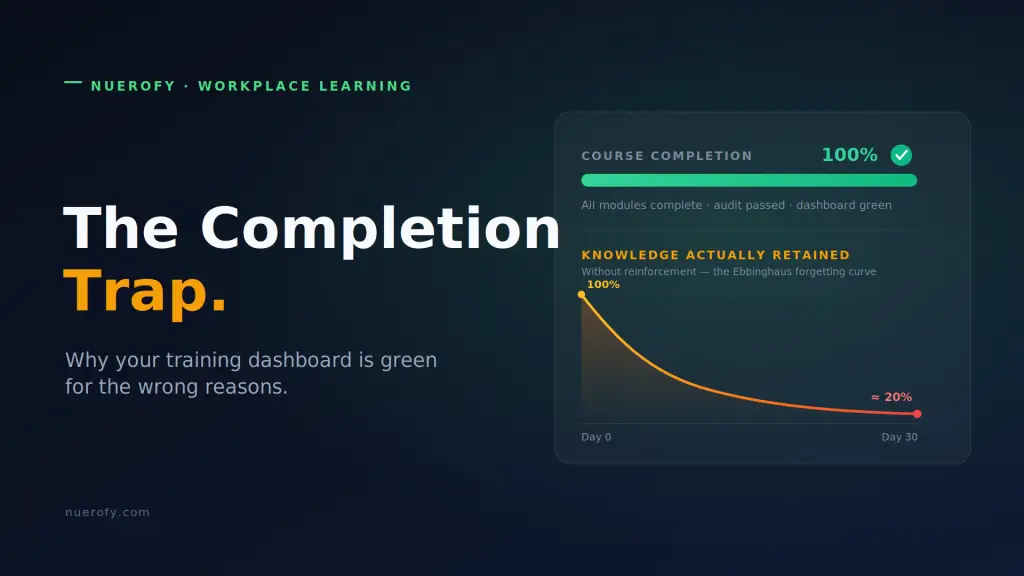

Walk into almost any L&D function and you’ll find a dashboard that’s mostly green. Compliance modules: complete. Onboarding pathways: complete. Annual refreshers: complete. The numbers are reassuring, auditable, and easy to put in front of a board.
They are also, quietly, measuring the wrong thing.
Completion has become the organising metric of corporate learning — the proxy we report, defend budgets with, and breathe a sigh of relief over. But completion was never the goal. It was always a stand-in for something far harder to capture: did anyone actually learn anything, and did their behaviour change as a result? For most of the history of workplace training, we measured completion not because it was meaningful, but because it was the only thing we could afford to measure at scale. That constraint is now gone, and it changes everything about what good L&D looks like.
The uncomfortable gap between “done” and “changed”
Start with the evidence that should keep every Head of Learning awake at night. Decades of research into training transfer — the degree to which what’s taught in a course shows up as changed behaviour on the job — has landed on a stubbornly low number. Across studies spanning years and industries, only a fraction of formal training content, often cited at around 10 to 20 per cent, reliably translates into sustained on-the-job behaviour. The completion rate can be 100 per cent. The transfer rate is frequently closer to 10.
Then layer on memory. Hermann Ebbinghaus mapped the “forgetting curve” in the 1880s, and it has been replicated relentlessly since: without reinforcement, people lose roughly half of newly learned information within hours and as much as 80 per cent within a month. A once-a-year, click-through-the-slides compliance module is, in effect, designed to be forgotten before it ever matters. The dashboard turns green in week one. The knowledge is gone by week four. When the moment of decision actually arrives — a phishing email at 5pm on a Friday, a safety shortcut under deadline pressure — the training is no longer in the room.
And we are trying to teach all of this to a workforce whose attention has fundamentally changed. The UC Irvine researcher Gloria Mark has tracked, using real behavioural logging rather than self-reports, a collapse in how long people sustain attention on a single screen — from around two and a half minutes two decades ago to roughly 47 seconds today. A 45-minute linear module isn’t just unfashionable. It is structurally mismatched to how human attention now works.
Put plainly: the dominant model of corporate training is built to be completed, not to be learned, and certainly not to change what people do. We have been optimising the wrong variable with great discipline.
Why we settled for it (and why that reason just expired)
It would be unfair to pin this on lazy L&D teams. The completion model wasn’t a failure of ambition; it was a rational response to economics.
The things that genuinely drive behaviour change have always been expensive to produce:
- Relevance. Training that reflects a specific role, sector, and risk context — not a generic one-size-fits-all course pushed to everyone identically.
- Currency. Content that keeps pace with regulation and practice, rather than ageing quietly in a library.
- Reinforcement. Spaced, repeated exposure that interrupts the forgetting curve, instead of one-and-done events.
- Personalisation. Letting people skip what they already know and spend their limited attention only where it counts.
Doing all four, for every role, in every language, kept up to date as the world changes, was simply not viable for most organisations. So they made a trade: buy generic content, deploy it uniformly, track completion, and accept that real behaviour change would be patchy. The green dashboard was the compromise we could afford.
That compromise is no longer necessary — and clinging to it is becoming a genuine liability. The World Economic Forum’s Future of Jobs Report 2025 estimates that 39 per cent of workers’ core skills will be transformed or rendered outdated between 2025 and 2030, and names the skills gap as the single biggest barrier to business transformation, cited by 63 per cent of employers. Analysts now put the half-life of a professional skill at roughly five years, and as little as two-and-a-half in fast-moving technical fields. When skills decay this fast, training that doesn’t actually stick isn’t just wasteful. It’s a structural risk to the business.
The real shift isn’t speed. It’s economics.
Here is where most of the conversation about AI in learning goes shallow. The headline everyone reaches for is speed: AI builds courses in minutes instead of weeks. True, and useful — but it misses the point. Building a forgettable course faster just gets you to a green dashboard sooner. If completion is the wrong metric, accelerating your way to it is not progress.
The deeper shift is that AI collapses the cost of exactly the four things that were always too expensive to do well: relevance, currency, reinforcement, and personalisation.
When generating role-specific content from your own policies costs almost nothing, generic training stops being a sensible default. When keeping a library current is automatic rather than a quarterly project, “we’ll update it next year” stops being an acceptable answer. When a placement test can route each learner around what they already know, you stop spending people’s scarce 47-second attention spans on material they don’t need. When reinforcement can be scheduled and personalised at scale, the forgetting curve becomes something you actively fight rather than passively lose to.
In other words: the constraint that forced us to settle for completion-as-a-proxy has been removed. The interesting question is no longer “how do we produce more training, faster?” It’s “now that behaviour-focused learning is finally affordable, why are we still measuring completion?”
What thought-leading L&D measures instead
The organisations that will pull ahead over the next few years are the ones that quietly retire the completion-first mindset and rebuild around outcomes. In practice, that looks like:
- Measuring capability, not consumption. Start from “what should this person be able to do differently?” and instrument for that — through application, assessment over time, and on-the-job indicators — rather than reporting hours and clicks.
- Designing for memory, not for the audit. Assume the forgetting curve is real and build spacing and reinforcement in from day one. A single annual module is a compliance artefact, not a learning strategy.
- Personalising ruthlessly. Respect attention as the scarce resource it has become. Let people skip what they know; spend their focus where the risk and the relevance actually are.
- Treating content as living, not archived. In a world where two-fifths of skills turn over within five years, “set and forget” libraries are a slow-motion compliance failure.
- Using AI to enable a better model, not to mass-produce the old one. The technology’s value is in making the expensive, behaviour-changing things cheap — not in industrialising the production of things people forget.
The bottom line
For thirty years, the corporate learning industry has measured the thing it could measure rather than the thing that mattered, because the thing that mattered was too expensive to deliver at scale. That era is ending. The forgetting curve hasn’t changed, attention spans have shrunk, and skills are decaying faster than ever — but for the first time, the tools to respond properly are within reach of every organisation, not just the ones with seven-figure L&D budgets.
The leaders won’t be the teams with the greenest completion dashboards. They’ll be the ones brave enough to admit the dashboard was never the point — and to start measuring whether their people can actually do the job, and keep doing it as the job keeps changing.
That’s the standard we hold ourselves to, and the future of workplace learning we’re building toward.
If this has you rethinking what your platform should be able to show you, our guide to choosing an AI-native LMS sets out the demo questions that surface real capability, analytics included.
The research behind this piece
The case above rests on evidence, not opinion. Decades of research into training transfer — most influentially work by Grossman and Salas — has repeatedly found that only around 10 to 20 per cent of formal training reliably becomes sustained on-the-job behaviour. Hermann Ebbinghaus’s “forgetting curve,” first mapped in the 1880s and replicated many times since, shows that without reinforcement people lose the majority of newly learned information within days, and as much as 80 per cent within a month. The World Economic Forum’s Future of Jobs Report 2025 projects that 39 per cent of workers’ core skills will be transformed or outdated between 2025 and 2030, and names the skills gap as the top barrier to business transformation. And UC Irvine professor Gloria Mark’s behavioural research documents the collapse of sustained attention on a single screen — from roughly two and a half minutes two decades ago to about 47 seconds today.
How Nuerofy thinks about this
Nuerofy is built for the model this article argues for — learning designed to change behaviour, not just to be completed. Our AI course builder turns your own policies and documents into interactive, role-relevant training, so relevance stops being a luxury. A continuously maintained library of 200+ accredited courses keeps content current instead of ageing in a folder. Placement tests route each learner around what they already know, protecting scarce attention. Adaptive learning journeys and AI-driven insights let you look past completion rates to what people can actually do — and keep doing as their roles change.
If your dashboard is green but you’re not sure your training is sticking, that’s exactly the gap we exist to close.
See how Nuerofy measures capability, not just completion → Book a demo