
For thirty years, workplace training meant “the course” — built over months, often out of date the day it launched. Artificial intelligence is quietly dismantling that model, and one of the largest, least-examined industries in the global economy is entering its biggest disruption in a generation.
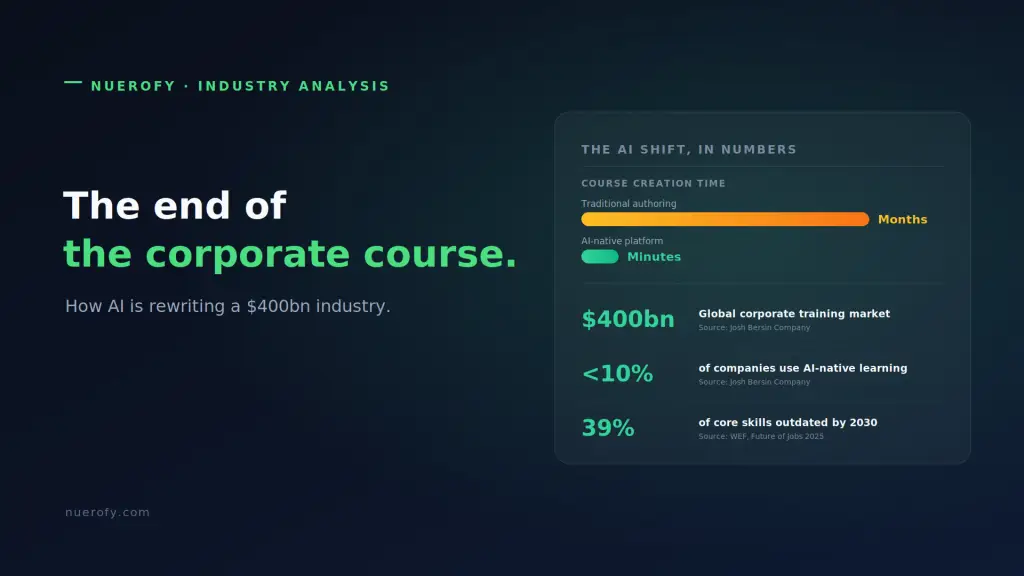
Every working adult knows the corporate course. The slide deck clicked through at onboarding. The annual compliance module completed at speed and forgotten by lunchtime. The training that arrived months after it was commissioned, describing a process that had already changed. For a generation, this was simply what workplace learning was — and it underpins an industry few outside it ever think about, worth an estimated $391 billion globally in 2025 and described by the Josh Bersin Company as a $400 billion market now being reinvented “faster than you imagined.”
That model is breaking. Not because the need for training has fallen — the opposite is true — but because the technology that built those courses, slowly and expensively, has been overtaken by technology that builds them in minutes. The implications run well beyond training departments, into how every organisation keeps its people safe, compliant and capable in an economy where skills now expire faster than ever.
A vast industry almost nobody is happy with
The first thing to understand about corporate training is its scale. Global investment in internal training topped $390 billion in 2024 and is projected to exceed $514 billion by the end of the decade, with the figure spent on training development reaching $102.8 billion in 2025 alone, according to Training Magazine’s industry data. By any measure, this is a major sector.
The second thing to understand is how dissatisfied its own customers are. The Josh Bersin Company’s research across 800 organisations found that fewer than 30% of companies are satisfied with how their workforce’s skills are developing, and separate industry surveys have put the share of training managers unhappy with their organisation’s e-learning strategy as high as three in four. A sector spending hundreds of billions of pounds is, on its own account, largely failing to deliver the thing it exists for: people who can actually do the changing work in front of them.
The reason is structural. The traditional course is static. It has to be designed, built, reviewed, translated and published — a process measured in months — and then it begins ageing immediately. In a stable world, that lag was tolerable. In a world where the World Economic Forum estimates that 39% of workers’ core skills will be transformed or outdated between 2025 and 2030, a training model that takes months to produce a single forgettable module is no longer fit for purpose.
From months to minutes
Here is the shift. Generative AI does not design a course and then freeze it; it generates learning dynamically from whatever material it is given. Upload a policy, a procedure, a safety bulletin or a product manual, and an AI-native platform can produce a structured, assessed, multilingual course in minutes rather than months. The Josh Bersin Company describes this as a move “from static training to dynamic enablement” — compressing what used to take a development cycle into a single afternoon, and keeping content current automatically as the source material changes.
The practical consequences are large:
- Speed — content that took months to author can be produced and deployed the same day, so training keeps pace with operational change instead of trailing it.
- Currency — when the underlying policy or procedure changes, the learning can be regenerated immediately rather than queued for the next review cycle.
- Reach — the same material can be delivered in dozens of languages at no extra production cost, reaching workforces that generic training never served well.
- Personalisation — AI assessment can route each learner around what they already know, a capability industry data links to roughly a 57% improvement in learning efficiency. None of this is speculative. It is already in commercial use, and it is the reason a thirty-year-old e-learning model is now widely described, even by its own analysts, as no longer sufficient.
The reality gap — and why it matters
For all the momentum, the most striking finding is how early this still is. The Josh Bersin Company’s research suggests fewer than one in ten companies have adopted genuinely AI-native learning. The technology is racing ahead of its own adoption.
Meanwhile, employees aren’t waiting. Cornerstone reported in 2026 that 46% of staff were already using AI tools at work without any formal employer training, and that 65% were building AI skills independently, in their own time, to stay competitive. That is a remarkable inversion: the workforce is teaching itself the most consequential new technology in a generation because employers have been too slow to do it for them. The gap between what people need to know and what their organisations are equipped to teach has rarely been wider — and it is precisely that gap the new tools are built to close. Industry surveys now find around 78% of companies planning to apply AI to content creation and more than nine in ten of those already using AI in learning intending to expand it.
Why this isn’t just an HR story
It would be easy to file all this under “HR technology” and move on. That would be a mistake, because workplace training is where some of the highest-stakes obligations in the economy are actually met. In manufacturing, training records are the evidence an inspector examines after a workplace fatality. In logistics, a lapsed certification is a vehicle that can’t legally move. In recruitment, healthcare, aviation and waste management, the ability to prove who was trained, on what, and when is the difference between passing an audit and losing the right to operate.
When the cost and speed of producing that training collapse, the effect isn’t just convenience. It changes who can afford to do training properly — extending capabilities once reserved for large enterprises to smaller organisations — and it changes how fast a business can respond when a regulation, a risk or a role changes overnight. In a labour market defined by skills shortages and constant reinvention, that is an economic story, not an administrative one.
The catch: speed without judgement is a liability
Sober coverage of this shift has to acknowledge the risks, because they are real. AI can generate a plausible-looking course on almost anything in minutes — including, if unchecked, one that is subtly wrong. In safety-critical and regulated training, “plausible” is not good enough; content has to be accurate, accredited where required, and signed off by someone accountable. Generative systems can hallucinate, reflect bias in their source material, or smooth over the nuance a regulation depends on.
The responsible version of this revolution therefore keeps humans firmly in the loop: AI accelerates the production of learning, but subject-matter experts verify it, accredited libraries underpin the compliance-critical material, and governance decides what may be generated and what must be reviewed. The organisations that win won’t be the ones that generate the most content fastest. They’ll be the ones that pair that speed with judgement — using AI to remove the months of manual effort while keeping the human accountability that high-stakes training demands.
A British example of the shift
The clearest way to see where this is heading is to look at the platforms built for it. The UK firm Nuerofy is one example of the AI-native approach in practice: its AI Studio turns an organisation’s own documents — policies, procedures, manuals — into structured, assessed courses in minutes, with voiceovers and delivery in 100+ languages, alongside AI placement tests that personalise each learner’s path and a library of 200+ accredited courses for the compliance-critical topics that need verified content rather than generated text. It is a concrete illustration of the broader pattern analysts are describing: the production of learning moving from a slow, specialist, months-long craft to something a small team can do in real time, while keeping accredited material for the areas where accuracy is non-negotiable.
Whether or not any single vendor leads the market, the direction is now hard to dispute. The course built over months, frozen on publication and forgotten by the workforce, is giving way to learning that is generated on demand, kept current automatically, and shaped around the individual.
For organisations moving now, the practical question becomes which AI-native platform fits, and our comparison of Nuerofy and Sana shows how two of the category’s platforms differ on pricing approach and what each licence includes.
The bottom line
The corporate course isn’t dead — traditional courseware will remain in place for years, particularly for established compliance programmes. But its monopoly is over. A $400 billion industry that changed remarkably little for three decades is now at the start of a replacement cycle that analysts expect to run for years, driven by a simple, stubborn fact: people need to learn faster than the old model can teach them. The businesses that recognise this early — and pair AI’s speed with human judgement — will spend less, move faster, and keep their people genuinely current. The ones that don’t will keep paying enterprise prices for training their own employees have already decided to do without.
Notes for editors
About Nuerofy. Nuerofy is a UK-based, AI-native learning management and experience platform (LMS/LXP) that helps organisations create, deliver and prove workforce training. Its AI Studio converts documents into interactive, assessed courses in minutes with delivery in 100+ languages, and it offers a library of 200+ RoSPA and CPD-accredited courses for compliance-critical training. Nuerofy works with organisations across regulated and high-hazard sectors including manufacturing, logistics, warehousing, recruitment, recycling and tourism.
For interviews, commentary or data on the AI shift in corporate learning, contact Sales@nuerofy.com or +44 (0)1527 280 007. More on the platform’s AI capabilities is available at nuerofy.com/ai-studio.
Figures in this article are drawn from publicly reported industry research, including the Josh Bersin Company, Training Magazine, Cornerstone and the World Economic Forum’s Future of Jobs Report 2025. Market-size and survey figures are estimates and vary between sources; readers should refer to the original publications for full methodology.