
Every profession has its paradox, and HR’s is this: the people responsible for the training of the entire organisation must, at the same time, keep themselves current in one of the fastest-moving legislative environments in British employment history — while maintaining their own professional CPD as CIPD members. HR and L&D professionals are simultaneously the custodians of everyone else’s compliance and the students of their own profession. When employment law changes — and right now it is changing faster than at any point in decades — both duties land at once.
The profession’s scale and standards are set by the CIPD, the world’s oldest HR professional body, with more than 160,000 members globally and a qualification framework (Levels 3, 5 and 7) that acts as the gold standard for people practice. This guide explains why L&D in the HR function itself is uniquely demanding and what a modern approach looks like. The data throughout draws on our State of HR Services Training Report 2026, worth reading in full if you work in the people profession.
The double duty, defined
No other professional group carries quite this combination. As practitioners, HR teams own the organisation’s compliance training governance: every employee’s mandatory modules delivered, refreshed and evidenced, from equality and data protection to fire safety and anti-bribery. As professionals, they carry their own CIPD CPD obligations and must stay personally current on legislation that changes beneath them. And increasingly they carry a third duty: advising the organisation on AI — its workforce implications, its ethics, and its legal risks — while learning to use it themselves. Every new Act, regulation or guidance note triggers all three duties simultaneously.
Why HR’s training burden is heavier than it looks
Three forces combine to make the people function one of the most stretched learning environments in any organisation.
- The dual obligation. HR manages and evidences every other person’s training while maintaining its own CIPD CPD — two parallel workloads that share one small team.
- Accelerating legislative change. The Employment Rights Act 2024/25, the Worker Protection Act 2023, day-one flexible working rights and the Equality (Race and Disability) Bill represent the most significant employment-law reform in decades — and every provision creates a manager and employee training requirement with a commencement deadline.
- The AI disruption of HR itself. CIPD Labour Market Outlook data shows 17% of employers expect AI-driven headcount reductions within 12 months; HR must understand AI well enough to use it strategically, govern it ethically, and train the organisation on it. Individually each is manageable; together they explain why so many HR teams feel permanently behind — and why the fix is capability, not longer hours.
The compliance estate HR must govern
The organisational training obligations that land on HR’s desk span every department and every level, and each must be delivered, refreshed and evidenced on a defined cycle. In practice the estate covers:
- Employment law and workplace rights — Equality, Diversity & Inclusion under the Equality Act 2010, the Worker Protection Act 2023 preventing-sexual-harassment duty (in force October 2024, with EHRC guidance naming training as a key indicator of compliance), unconscious bias for hiring managers, and disability awareness and reasonable adjustments for people managers.
- Data protection and information security — annual UK GDPR and Data Protection Act 2018 training for all staff, cyber security awareness, and records-management obligations including retention and the right to erasure.
- Health, safety and wellbeing — Health & Safety at Work awareness, fire safety, Display Screen Equipment for desk and home workers, and mental health awareness with enhanced Mental Health First Aid for designated champions.
- Governance and ethics — anti-bribery under the Bribery Act 2010, whistleblowing policy awareness, modern slavery awareness for management and procurement, and AML for financially exposed functions. Tracked in spreadsheets, this estate consumes an HR team; automated, it becomes a dashboard the team supervises rather than a treadmill it runs on.
Employment law is moving — and every change is a training event
This is the defining pressure of 2026. The Worker Protection Act’s preventative duty means employers must take reasonable steps to prevent sexual harassment — and if training hasn’t been built, deployed and evidenced for all staff, the duty is arguably not met. Day-one flexible working rights mean line managers must handle statutory requests correctly, understand the grounds for refusal, and document decisions that can withstand tribunal scrutiny. The Employment Rights Act’s provisions — day-one unfair dismissal protections, fire-and-rehire restrictions, expanded consultation requirements — each demand that HR update its own knowledge and train line managers before commencement dates. The old model, where a training need waited weeks for content development, simply cannot keep pace with legislation that arrives with a date attached.
The sharpest of those dates is now 30 October 2026, when the harassment duty rises from “reasonable steps” to “all reasonable steps” and extends to third parties, and our guide to what changes on 30 October covers what HR teams need in place.
HR’s own development: CIPD CPD and the profession map
Alongside all of it sits HR’s own professional obligation. CIPD members maintain CPD as the foundation of their professional credibility, across a qualification ladder from the Level 3 Foundation Certificate through the Level 5 Associate Diploma to the Level 7 Advanced Diploma and Chartered MCIPD status. The CIPD Profession Map defines nine specialist disciplines — from People Analytics to Employee Relations — each generating its own development needs. The practical problem is oversight: when practitioners log CPD in personal spreadsheets while managing the organisation’s training in another system, their own development becomes the least-evidenced learning in the building. The elegant fix is to track it on the same platform that runs everything else.
AI in HR: use it, govern it, teach it
AI is transforming HR practice at speed — recruitment screening, performance analytics, workforce planning, AI-generated learning content — and it hands HR three jobs at once. First, use it: L&D practitioners who master AI course building can create training around ten times faster than traditional authoring, translate content automatically, and personalise pathways with AI assessment. Second, govern it: algorithmic bias in recruitment engages Equality Act obligations, automated decision-making engages UK GDPR, and the organisation needs an AI governance policy that HR helps write. Third, teach it: managers and employees need AI awareness training before tools are rolled out. The practitioners who build these capabilities in 2026 will be significantly more valuable than those who wait — and they’ll be advising their boards rather than reacting to them.
From administration to intelligence
The most underused asset in the HR function is its own training data. Spreadsheet-managed compliance produces backward-looking reports: who completed what, when. A modern platform turns the same data forward-looking: which teams are at risk of compliance lapses in the next 30 days, where the knowledge gaps sit ahead of a legislative change, which managers have the weakest team completion rates. That shift — from administrative record to strategic people intelligence — is what lets HR demonstrate learning ROI to the board and position itself as a data-led function rather than an administrative service.
How a modern, AI-native approach solves it
This is the gap that purpose-built Learning & Development for HR services is designed to close. Rather than juggling disconnected systems, an AI-powered learning platform brings the whole double duty — organisational compliance, HR’s own CPD, and legislative-change training — into one place:
- 200+ RoSPA and CPD-accredited courses covering the full compliance estate — ED&I, data protection, cyber security, health and safety, anti-bribery, mental health awareness — deployable on day one, with the Worker Protection Act 2023 duty reflected.
- An AI course builder that converts legal guidance, policy updates and HR briefing documents into structured manager and employee training in hours — so a flexible-working manager briefing or an EHRC-guidance harassment module is built, deployed and evidenced before the law commences.
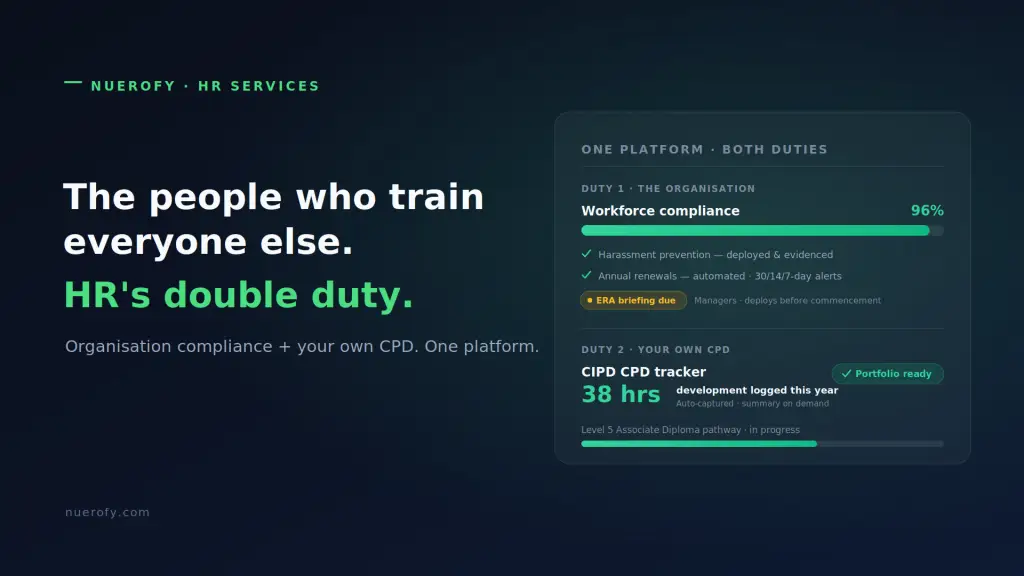
- Automated renewal management so every annual mandatory module re-enrols itself, with 30/14/7-day alerts — ending manual chasing entirely.
- Personal CIPD CPD tracking for HR professionals themselves, automatically logging development activity and generating a portfolio summary on demand — on the same platform as the organisation’s training.
- Real-time compliance dashboards and board packs — completion rates by team, department and level at a glance, board-level summaries in under a minute, and line-manager analytics that surface risk before it becomes a lapse.
- 100+ language delivery so diverse workforces receive consistent, high-quality training, with onboarding programmes built from your actual handbook and policy suite rather than generic content. The result is a people function that keeps the whole organisation compliant, keeps itself current and CPD-evidenced, and moves at the speed employment law now demands — without growing the team.
What “good” looks like — a quick checklist
If you’re assessing your own people function, answer these honestly:
- Do all annual mandatory modules re-enrol automatically, with alerts before they lapse?
- Could you evidence your Worker Protection Act 2023 “reasonable steps” — deployed, completed harassment-prevention training — today?
- When new legislation is announced, can you build and deploy manager training before its commencement date?
- Is your own CIPD CPD tracked and portfolio-ready on the same platform as the organisation’s training?
- Can you show the board forward-looking compliance risk, not just backward-looking completions?
- Have managers been trained on AI tools’ Equality Act and GDPR implications before rollout? If several answers are “no,” the exposure is double-sided — organisational compliance risk on one hand, and HR’s own professional credibility on the other.
See it built for your people function
The fastest way to grasp the difference is to see your own scenarios — an Employment Rights Act manager briefing, a harassment-prevention rollout, your own CPD portfolio — running on a platform built for the people profession. Book a demo and we’ll walk through it, or start a free trial and have real training live within days. For the full picture of the profession’s challenges and data, read the State of HR Services Training Report 2026.
Frequently asked questions
What compliance training must HR manage for the whole organisation? A universal estate applies across every department: Equality, Diversity & Inclusion, preventing sexual harassment (Worker Protection Act 2023), UK GDPR and data protection, cyber security, health and safety, fire safety, DSE, mental health awareness, anti-bribery and — where relevant — whistleblowing, modern slavery and AML. Each must be delivered, refreshed on a defined cycle and evidenced.
What does the Worker Protection Act 2023 require of employers? Since October 2024, employers must take reasonable steps to prevent sexual harassment at work, and EHRC guidance indicates that deployed, evidenced staff training is a key indicator of compliance. HR teams should build, deploy and track completion of harassment-prevention training for all staff, with managers trained on their role in prevention and response.
How can HR keep up with employment law changes like the Employment Rights Act? By converting legal guidance into training at the speed of legislation — an AI course builder can turn a briefing on new provisions into structured line-manager training in hours, deployed and evidenced before commencement dates, rather than weeks after.
How should HR professionals track their own CIPD CPD? On the same platform used for the organisation’s training — automatically logging development activity and generating a CIPD portfolio summary on demand. This closes the common gap where HR’s own development is the least-evidenced learning in the organisation.
What AI skills do HR and L&D professionals need in 2026? Three layers: practical use (AI course building, AI-assisted analytics), governance (algorithmic bias and Equality Act obligations, UK GDPR automated decision-making rules, organisational AI policy) and education (training managers and employees on responsible AI use before tools are deployed).
Can training be delivered to diverse, multilingual workforces? Yes — courses can be delivered with AI voiceovers in 100+ languages, so every employee receives consistent, high-quality compliance and development training in the language they work best in.