
The learning management system market is changing faster than ever before.
For years, businesses relied on traditional LMS platforms that focused heavily on compliance, course delivery, and reporting. While these systems solved basic training requirements, they often created new problems in the process. Many became slow to manage, difficult to scale, and frustrating for learners to use.
Now, a new generation of AI-powered learning platforms is redefining what workplace training looks like.
Terms such as “AI LMS”, “AI-powered learning platform”, and “AI course creation software” are rapidly increasing in search demand as organisations look for faster, smarter, and more cost-effective ways to train their workforce.
The shift is no longer coming — it is already happening.
What Is an AI LMS?
An AI LMS is a learning platform that uses artificial intelligence to automate and improve the process of creating, delivering, managing, and optimising training.
Unlike traditional LMS systems, AI-powered platforms can:
- Generate course structures automatically
- Create learning content in minutes
- Personalise training pathways
- Analyse learner behaviour
- Identify knowledge gaps
- Recommend relevant learning content
The goal is not simply to digitise training. It is to make learning faster, more adaptive, and significantly easier to manage.
Why Traditional LMS Platforms Are Struggling
Many businesses are discovering that older LMS systems no longer align with how modern organisations operate.
Traditional platforms were built for a different era — one where training was:
- Static
- Scheduled
- Admin-heavy
- Compliance-focused
Today’s workplaces move far more quickly.
Processes change constantly. Teams evolve rapidly. New technologies emerge overnight. Businesses need learning systems that can adapt immediately rather than requiring weeks or months of administration.
This is where traditional systems often struggle.
Even modern enterprise platforms can become:
- Overly complex
- Expensive to scale
- Slow to implement
- Difficult to manage without dedicated teams
The result is that many organisations spend more time managing learning systems than improving learning itself.
The Rise of AI-Powered Learning Platforms
AI is changing this completely.
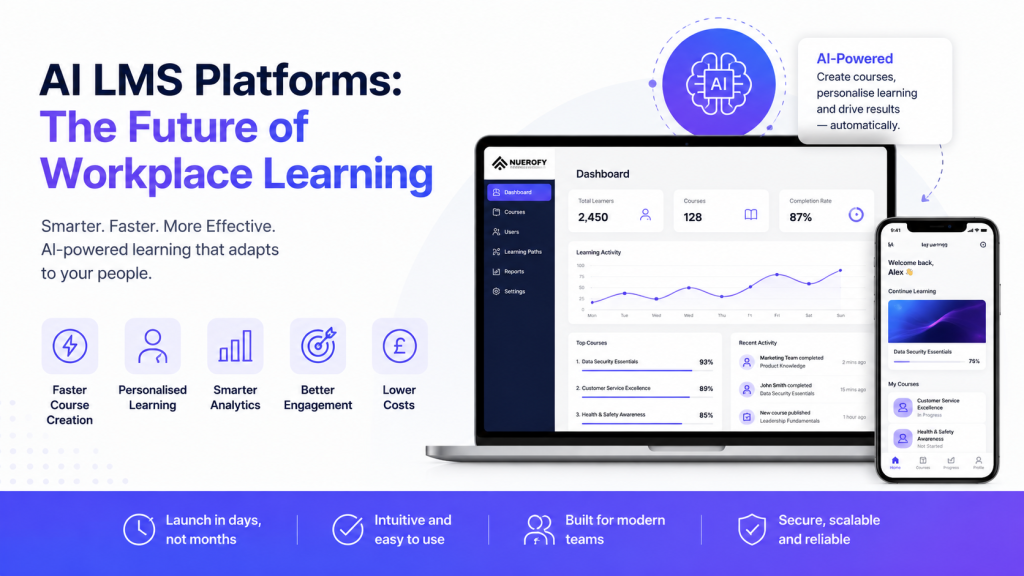
Modern AI LMS platforms allow organisations to create professional-quality training in a fraction of the time previously required.
Instead of building courses manually from scratch, administrators can now generate:
- Entire course structures
- Learning objectives
- Assessments
- Interactive content
- Knowledge checks
Using simple prompts and AI-assisted workflows.
This dramatically reduces the operational burden traditionally associated with eLearning creation.
Faster Course Creation Is Changing Everything
Course creation has historically been one of the biggest bottlenecks in workplace learning.
Traditional development often involved:
- Subject matter experts
- Instructional designers
- Developers
- Graphic designers
- Multiple review stages
This process could take weeks for even relatively straightforward courses.
AI-powered platforms now compress this into minutes.
An organisation can input a topic such as:
“Create a GDPR training course for UK office staff”
And instantly receive:
- Structured modules
- Suggested content
- Quiz questions
- Learning pathways
This fundamentally changes the economics of workplace training.
Personalised Learning Is Becoming the Standard
Another major advantage of AI LMS platforms is personalisation.
Traditional learning systems typically deliver the same training to everyone regardless of:
- Role
- Experience level
- Performance
- Knowledge gaps
AI platforms take a different approach.
By analysing learner behaviour and engagement, they can adapt learning pathways dynamically. Employees receive more relevant content, reducing wasted training time and improving engagement.
This creates a learning experience that feels:
- More relevant
- More engaging
- More efficient
Rather than simply mandatory.
Why User Experience Matters More Than Ever
One of the biggest problems with many legacy LMS platforms is usability.
Even powerful systems fail when employees avoid using them.
Modern learners expect software to feel:
- Fast
- Intuitive
- Mobile-friendly
- Clean and uncluttered
This expectation has been heavily influenced by consumer technology. Employees now compare workplace software to the apps and platforms they use every day.
AI LMS platforms are increasingly designed around this expectation, focusing heavily on:
- Simplicity
- Modern interface design
- Reduced friction
- Faster workflows
The result is significantly higher adoption and engagement.
AI LMS Platforms Reduce Operational Costs
One of the biggest reasons businesses are moving towards AI-powered learning platforms is cost efficiency.
Traditional LMS environments often involve:
- High implementation costs
- Expensive onboarding
- Ongoing administration overhead
- External course development costs
AI dramatically reduces many of these expenses.
Because content can be generated and updated internally, businesses become less reliant on external providers. Training can also be created much faster, reducing delays and increasing responsiveness.
Over time, this creates a much leaner and more scalable training model.
The Shift Towards Leaner Learning Platforms
The market is increasingly moving away from bloated systems filled with underused functionality.
Businesses now want:
- Faster deployment
- Easier management
- Transparent pricing
- Simplified workflows
- Better ROI
This has created strong demand for modern platforms like Neurofy that focus on:
- AI-driven workflows
- Rapid course creation
- Clean, modern interfaces
- Faster implementation
- Lower operational overhead
Rather than relying on heavy enterprise complexity.
Why AI LMS Search Demand Is Growing Rapidly
Search interest around terms such as:
- AI LMS
- AI learning platform
- AI course creator
- AI training software
- LMS with AI
- AI eLearning platform
Has grown significantly over the last 18 months.
This reflects a wider market shift. Businesses are actively looking for alternatives to:
- Traditional LMS systems
- Slow implementation cycles
- High-cost enterprise platforms
The demand is now centred around speed, usability, and automation.
The Future of Workplace Learning
The next generation of learning platforms will look very different from the systems organisations adopted five or ten years ago.
The future is likely to be defined by:
- AI-assisted learning creation
- Personalised training journeys
- Real-time adaptation
- Simplified management
- Faster deployment
Organisations that embrace this shift early are likely to gain a major advantage in:
- Workforce development
- Operational agility
- Compliance responsiveness
- Employee engagement
Final Thoughts
AI LMS platforms are not simply an upgrade to traditional learning systems. They represent a completely different way of thinking about workplace learning.
The focus is no longer on building large, complex systems that require heavy management. It is on creating platforms that help organisations move faster, train smarter, and reduce friction across the entire learning process.
As businesses continue searching for more efficient and scalable ways to deliver training, AI-powered learning platforms are rapidly becoming the new standard.
And this is only the beginning.