
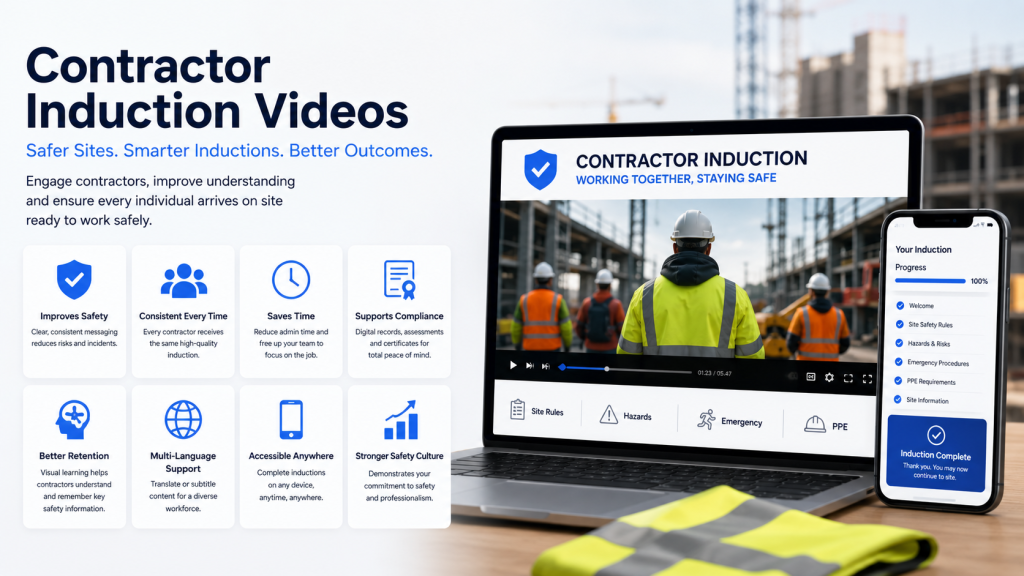

Every year, thousands of contractors arrive at workplaces, construction sites, manufacturing facilities, warehouses, offices, and infrastructure projects across the UK. Before they can begin work, they need to understand the site’s rules, hazards, emergency procedures, and safety expectations.
Traditionally, this process has been handled through face-to-face briefings, PowerPoint presentations, paper handouts, or lengthy induction meetings.
While these methods have served organisations for decades, many businesses are now discovering they are inefficient, inconsistent, and increasingly difficult to manage at scale.
As a result, contractor induction videos are becoming one of the fastest-growing areas of workplace learning and safety communication.
By combining video, animation, narration, and digital learning technology, organisations can deliver a consistent induction experience that improves safety, strengthens compliance, and significantly reduces administration.
The Problem with Traditional Contractor Inductions
Most organisations recognise the importance of contractor inductions. The challenge is not whether they should happen, but how they are delivered.
In many workplaces, inductions rely heavily on the availability of supervisors, site managers, or health and safety personnel. Every time a contractor arrives, someone needs to stop what they are doing and repeat the same information.
This creates several problems.
The first is inconsistency. Different managers explain things differently. Some cover every point thoroughly, while others focus only on the essentials. Over time, important information can be missed or diluted.
The second issue is efficiency. Valuable management time is spent repeatedly delivering the same induction to different contractors. Across a large organisation, this can add up to hundreds of hours every year.
The third challenge is retention. Research consistently shows that people remember information more effectively when it is delivered visually and reinforced through multiple formats. A verbal briefing alone is often forgotten within hours.
Creating a Consistent Safety Message
One of the biggest benefits of contractor induction videos is consistency.
Every contractor receives exactly the same information, delivered in exactly the same way.
This ensures critical topics are always covered, including:
- Site hazards
- Emergency arrangements
- Personal protective equipment requirements
- Traffic management systems
- Welfare facilities
- Reporting procedures
- Environmental requirements
- Site-specific rules
Consistency is particularly important for organisations operating across multiple locations.
A professionally produced induction video ensures that regardless of who is delivering the induction, the key safety messages remain unchanged.
Improving Contractor Engagement
Let’s be honest. Most contractors have attended countless inductions throughout their careers.
Many have sat through presentations that are text-heavy, repetitive, and uninspiring.
Video changes the experience significantly.
By using:
- Real site footage
- Drone footage
- Animation
- Professional narration
- Visual demonstrations
- Graphics and motion design
Organisations can present information in a way that is more engaging and easier to understand.
Rather than simply telling contractors what to do, videos can show them.
This visual approach helps improve understanding, particularly for site-specific procedures that may be difficult to explain verbally.
Better Knowledge Retention
Safety information only has value if people remember it.
Video is one of the most effective methods for improving information retention because it combines multiple learning styles simultaneously.
Contractors can:
- Hear the information
- See the environment
- Watch demonstrations
- Follow visual instructions
This creates stronger recall than written documents or verbal briefings alone.
When contractors arrive on site, they already have a clearer understanding of what is expected of them and how they should behave.
Supporting Compliance and Audit Requirements
Documentation is a critical part of contractor management.
Many organisations need evidence that contractors have:
- Received an induction
- Understood the content
- Completed any required assessments
Digital induction systems linked to video content provide a clear audit trail.
Completion records, assessment results, timestamps, and certificates can all be recorded automatically.
This creates valuable evidence for:
- Health and safety audits
- Client inspections
- ISO management systems
- Contractor management processes
- Regulatory investigations
In the event of an incident, organisations can demonstrate that appropriate induction procedures were followed.
Reducing Administrative Burden
For many businesses, the biggest benefit is operational efficiency.
A contractor induction video effectively turns a process that normally requires a manager into a self-service experience.
Contractors can complete inductions:
- Before arriving on site
- From their mobile device
- From home
- At a hotel
- Whilst travelling
This means they arrive ready to work rather than spending valuable site time completing paperwork and briefings.
Managers can then focus on site operations rather than repeating the same induction dozens of times each month.
Improving Contractor Experience
The contractor experience is often overlooked.
First impressions matter.
When contractors arrive at a site and are immediately faced with lengthy paperwork or lengthy presentations, it can create frustration before work has even started.
A modern video induction demonstrates professionalism and organisation.
It shows that the company takes safety seriously while respecting the contractor’s time.
This can contribute positively to working relationships and site culture.
Supporting Multi-Language Workforces
Many industries now rely on increasingly diverse workforces.
Construction, logistics, manufacturing, engineering, and infrastructure projects often involve contractors from multiple countries and backgrounds.
Video induction systems can be:
- Translated into multiple languages
- Subtitled
- Narrated in different languages
This dramatically improves accessibility and reduces the risk of misunderstandings caused by language barriers.
Site-Specific Inductions Without Additional Effort
One common concern is that every site is different.
Fortunately, contractor induction videos can be customised to reflect specific locations, hazards, and procedures.
A video can include:
- Site entrances
- Emergency exits
- Muster points
- Traffic routes
- Restricted areas
- Equipment requirements
- Local safety rules
This allows contractors to familiarise themselves with the environment before they even arrive.
Enhancing Safety Culture
Perhaps the greatest benefit of all is the impact on safety culture.
A professionally produced induction video sends a clear message that safety is a priority.
It demonstrates that the organisation has invested time and effort into ensuring contractors understand their responsibilities.
This creates a stronger foundation for safe behaviours from the moment contractors arrive on site.
When people understand expectations clearly, they are more likely to comply with them.
The Future of Contractor Inductions
The shift towards digital contractor inductions is accelerating across virtually every industry.
Organisations are increasingly recognising that video-based inductions are not simply a more modern version of traditional briefings. They are a fundamentally better way to communicate safety information.
As learning platforms continue to evolve, contractor induction videos are becoming integrated into wider contractor management systems, enabling organisations to combine:
- Video learning
- Online assessments
- Digital records
- Automated reminders
- Competency management
- Compliance reporting
This creates a far more efficient and scalable approach to contractor onboarding.
Final Thoughts
Contractor induction videos are no longer a luxury reserved for large organisations. They are rapidly becoming a best practice for businesses that want to improve safety, strengthen compliance, and reduce administration.
By delivering consistent, engaging, and memorable safety information, video inductions help contractors arrive better prepared, more informed, and ready to work safely from day one.
For organisations looking to modernise their contractor management processes, few investments can deliver such immediate and long-lasting benefits.