

Training Data Has Been Underused for Too Long
Most organisations collect large amounts of training data.
They track course completions, assessment scores, certification dates, and engagement metrics. Over time, this builds into a substantial dataset that, in theory, should provide valuable insight.
In practice, it rarely does.
Data is often stored in dashboards that are difficult to interpret. Reports are generated periodically, reviewed briefly, and then archived. By the time insights are identified, the moment to act has often passed.
The issue is not a lack of data.
It is the inability to use it effectively.
Why Traditional Reporting Falls Short
Traditional learning platforms were designed to record activity, not to interpret it.
They answer basic questions such as who completed training and when. While this information is useful for administration, it offers limited value for decision-making.
It does not explain why engagement is low, where performance gaps exist, or how training could be improved.
More importantly, it does not support real-time action.
Organisations are left reacting to reports rather than actively managing learning and performance as it happens.
The Shift from Reporting to Real-Time Intelligence
Artificial intelligence is changing this dynamic.
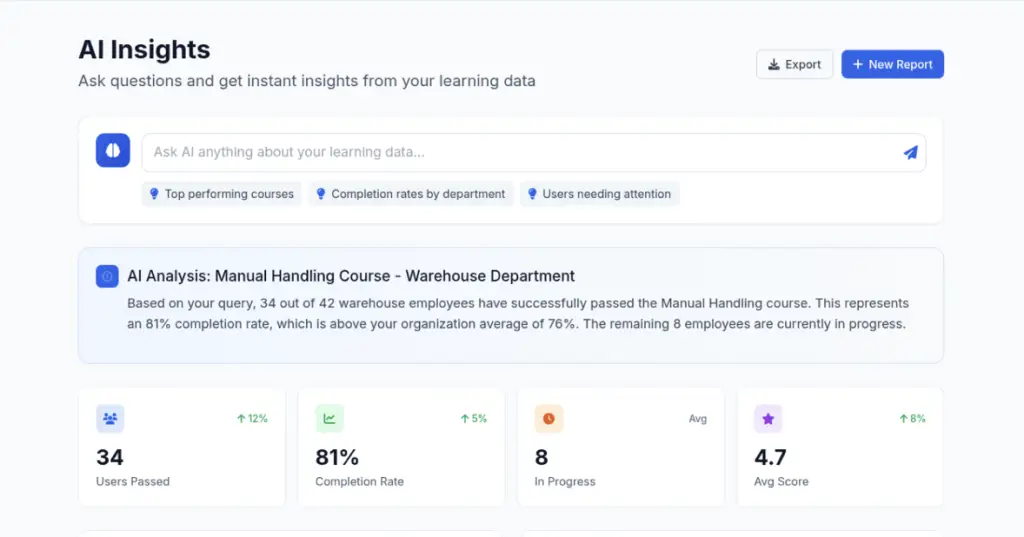
Instead of relying on static reports, organisations can now interact with their training data in real time. They can ask questions, explore patterns, and receive immediate, meaningful answers.
This represents a fundamental shift.
Training data moves from being a record of the past to a tool for managing the present.
It becomes something that can be used actively, not just reviewed periodically.
Ask Questions, Get Answers
One of the most significant developments in this space is the ability to query learning data using natural language.
This removes a major barrier.
Traditionally, accessing insights required technical knowledge or manual report building. Now, administrators can simply ask questions in plain language.
They might ask which teams are falling behind on compliance, where engagement has dropped, or which courses are delivering the best results.
The system responds instantly with clear, structured insights.
This changes who can access data and how quickly they can act on it.
From Dashboards to Dynamic Exploration
Dashboards have long been a core part of learning platforms.
However, they are often static. They present predefined metrics that may not reflect the specific questions an organisation needs to answer at any given time.
AI introduces a more dynamic approach.
With Nuerofy, users can explore data in real time, drilling down into specific areas to understand what is happening beneath the surface. A high-level view can quickly lead to detailed analysis, allowing organisations to move from overview to insight without friction.
This level of flexibility makes data far more useful.
It allows organisations to investigate issues as they arise rather than relying on pre-built reports.
Real-Time Visibility Across the Workforce
One of the most powerful aspects of AI-driven analytics is real-time visibility.
Organisations no longer need to wait for reports to understand their training position. They can see progress, engagement, and performance as it happens.
This has a direct impact on how training is managed.
If engagement drops, it can be addressed immediately. If compliance gaps appear, they can be resolved before they become issues. If certain courses are underperforming, they can be reviewed and improved quickly.
This level of responsiveness was not possible with traditional systems.
From Insight to Action
Data becomes valuable when it leads to action.
AI-powered learning platforms do not just present information. They enable organisations to act on it.
Insights can be saved, tracked, and integrated into dashboards, ensuring that key information remains visible. Patterns can be monitored over time, allowing organisations to measure the impact of changes and refine their approach.
This creates a continuous improvement cycle.
Training is no longer static. It evolves based on real data and real outcomes.
The Role of Predictive Analytics
Beyond real-time insight, AI introduces the ability to anticipate issues before they occur.
Predictive analytics can identify trends and highlight potential risks. For example, it can flag areas where compliance may fall below required levels or where engagement is likely to decline.
This allows organisations to act proactively rather than reactively.
Instead of responding to problems after they arise, they can prevent them altogether.
This shift has significant implications for risk management and operational efficiency.
Compliance Monitoring Without the Lag
Compliance is one of the areas where real-time AI has the greatest impact.
Traditional approaches rely on periodic checks and manual reporting. This creates gaps between training activity and compliance visibility.
AI removes this lag.
Organisations can monitor compliance continuously, ensuring that requirements are met at all times. They can identify gaps instantly and take corrective action without delay.
This not only reduces risk but also simplifies audit preparation, as data is always up to date and readily accessible.
Improving Learning Performance at Scale
Training is not just about compliance. It is about performance.
AI-powered insights allow organisations to understand how learning impacts performance across the workforce. They can identify which courses are effective, which need improvement, and how different groups respond to training.
This level of insight supports better decision-making.
Organisations can optimise their training programmes, focusing on what works and refining what does not. Over time, this leads to more effective learning and stronger outcomes.
Why This Matters Now
The pace of change within organisations is increasing.
Workforces are distributed, operations are more complex, and expectations are higher. Training needs to keep up with these changes, and so does the way it is managed.
Static reporting systems cannot meet these demands.
Real-time AI analytics provides the speed, flexibility, and insight required to manage training effectively in modern environments.
It allows organisations to move from reactive management to proactive control.
What the Future Looks Like
The role of AI in learning platforms will continue to expand.
Natural language interaction will become standard. Real-time analytics will replace periodic reporting. Predictive insight will become a core part of decision-making.
Over time, the distinction between training data and operational data will begin to blur.
Learning platforms will not just support training. They will support how organisations understand and manage their workforce.
Frequently Asked Questions
What are AI-powered learning insights?
AI-powered learning insights use artificial intelligence to analyse training data and provide real-time, actionable information about performance, engagement, and compliance.
What are natural language queries in an LMS?
Natural language queries allow users to ask questions in plain English and receive instant, data-driven answers without needing technical expertise.
How does real-time learning analytics improve training?
It enables organisations to monitor performance as it happens, identify issues quickly, and take immediate action to improve outcomes.
What is predictive analytics in training?
Predictive analytics uses AI to identify trends and forecast potential issues, allowing organisations to act before problems arise.
Final Thought
Training data has always had value.
The difference now is that organisations can finally use it properly.
AI is turning data into intelligence, and intelligence into action. This is what allows training to move beyond administration and become a core part of how organisations operate.
Ready to Turn Data Into Insight?
The next step is not collecting more data.
It is using it to make better decisions, faster.