

Most Training Starts in the Wrong Place
In many organisations, training begins with an assumption.
Everyone starts at the same point. Everyone completes the same course. Everyone follows the same path.
On paper, this creates consistency.
In reality, it creates inefficiency.
Some employees already understand large portions of the material. Others may lack foundational knowledge. Yet both groups are asked to complete identical training.
This leads to wasted time, disengagement, and slower development.
The issue is not the content.
It is the starting point.
The Case for Smarter Entry Into Learning
Effective training should begin with understanding.
Before assigning courses, organisations need to know what their workforce already knows and where the gaps exist. Without this, training becomes a blunt instrument, delivering information that may not be needed or may not be sufficient.
This is where placement testing becomes critical.
However, traditional placement tests have limitations. They are often static, time-consuming, and disconnected from the broader learning process.
AI changes this completely.
What AI-Driven Placement Tests Do Differently
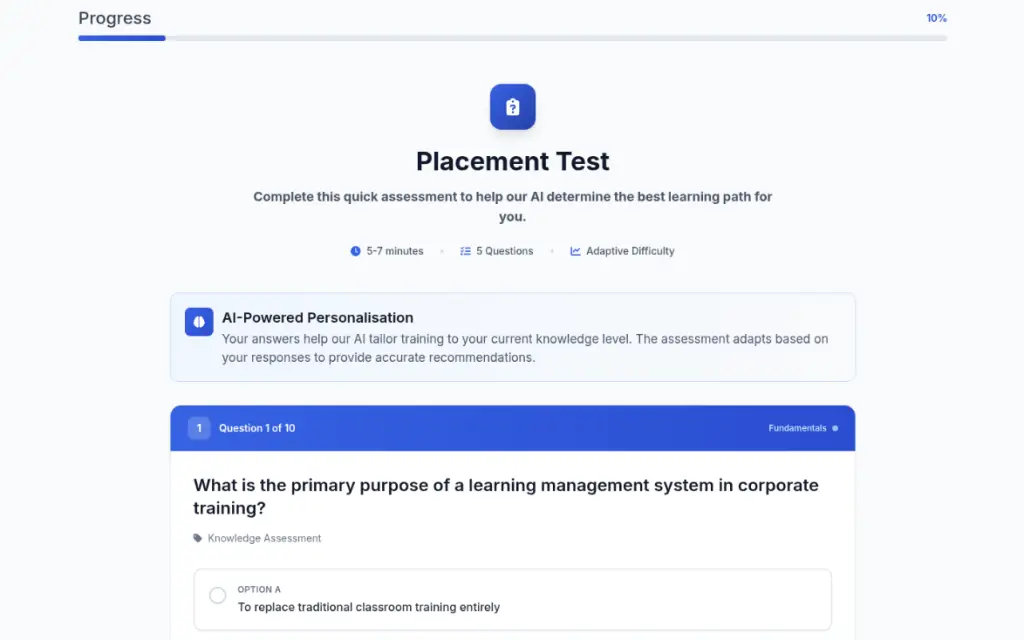
AI-driven placement tests move beyond fixed assessments.
Instead of presenting the same set of questions to every learner, the system adapts in real time. Each response influences the next question, allowing the assessment to quickly identify a learner’s level of understanding.
This creates a far more efficient process.
Learners are not required to answer unnecessary questions. Instead, the system focuses on identifying knowledge gaps with precision.
The result is a faster, more accurate evaluation.
Real-Time Skill Evaluation That Adapts to the Learner
One of the defining features of AI-driven placement tests is adaptability.
As learners progress through the assessment, the difficulty adjusts dynamically. If a learner demonstrates strong understanding, the system moves forward quickly. If gaps are identified, it explores those areas in more detail.
This approach provides a clear picture of capability without unnecessary repetition.
It also improves the learner experience. Assessments feel more relevant and less repetitive, which encourages engagement from the outset.
From Assessment to Action
The true value of placement testing lies in what happens next.
In traditional systems, assessments are often treated as standalone activities. Results may be recorded, but they do not always influence the learning journey in a meaningful way.
AI-driven systems take a different approach.
Assessment results are used immediately to shape training. Learning paths are generated based on individual performance, ensuring that each learner receives content that is relevant to their needs.
This creates a direct connection between assessment and development.
Personalised Learning at Scale
Personalisation has long been a goal in training, but it has been difficult to achieve in practice.
Manual approaches require significant time and effort. As a result, many organisations default to standardised training programmes.
AI removes this barrier.
By analysing placement test results, systems can build tailored learning journeys automatically. Each learner receives a pathway that focuses on their specific gaps and development areas.
This makes personalisation scalable.
Organisations can deliver targeted training across large workforces without increasing administrative effort.
Reducing Training Time Without Reducing Quality
One of the most immediate benefits of AI-driven placement testing is efficiency.
When learners skip content they already understand, training becomes more focused. Time is spent on areas that require development rather than revisiting familiar material.
This can significantly reduce overall training time.
In many cases, organisations see reductions of up to 60 percent.
Importantly, this does not compromise quality. In fact, it often improves it.
Learners engage more because the content is relevant. They progress faster because unnecessary steps are removed. And outcomes improve because training is aligned with real needs.
Improving Engagement Through Relevance
Engagement is a persistent challenge in training.
When learners are asked to complete content that feels repetitive or irrelevant, motivation drops. Completion becomes a task rather than a meaningful activity.
AI-driven placement testing addresses this at the source.
By ensuring that learners only engage with content that matters, it creates a more focused and engaging experience. Training feels purposeful, which increases participation and retention.
This has a direct impact on overall effectiveness.
Dynamic Difficulty and Continuous Development
Learning is not static.
As employees develop, their needs change. Training systems need to reflect this.
AI-driven approaches allow for continuous adjustment. Difficulty can be increased as learners progress, ensuring that development continues over time.
This prevents stagnation and supports ongoing improvement.
It also ensures that training remains aligned with evolving roles and responsibilities.
Why This Matters for Modern Organisations
Workforces are becoming more diverse, more distributed, and more complex.
Standardised training models struggle to keep up with these changes. They lack the flexibility and responsiveness required to support modern environments.
AI-driven placement testing provides a solution.
It allows organisations to understand their workforce at a granular level and deliver training that reflects that understanding.
This leads to better outcomes, reduced inefficiencies, and stronger performance.
What the Future of Training Looks Like
Placement testing is no longer just an entry point.
It is becoming a continuous part of the learning process.
AI will increasingly be used to assess capability in real time, adapt learning paths dynamically, and ensure that training evolves alongside the workforce.
This creates a system where learning is always aligned with need.
It moves training away from fixed programmes and towards adaptive, intelligent systems.
Frequently Asked Questions
What is an AI-driven placement test?
An AI-driven placement test uses adaptive questioning to assess a learner’s knowledge quickly and accurately, adjusting difficulty based on responses.
How do placement tests improve training?
They identify knowledge gaps upfront, allowing training to focus on relevant areas and avoid unnecessary content.
Can AI reduce training time?
Yes, by skipping content learners already understand, AI-driven systems can reduce training time significantly while improving outcomes.
Are placement tests suitable for all industries?
Yes, they can be applied across sectors wherever training needs to be tailored to different roles, skills, or experience levels.
Final Thought
Training should not start with assumptions.
It should start with understanding.
AI-driven placement testing makes this possible at scale. It ensures that every learner begins in the right place and follows a path that reflects their needs.
This is how training becomes faster, more effective, and more meaningful.
Ready to Personalise Training From the Start?
The next step is not creating more courses.
It is ensuring every learner starts in the right place.