
In most industries, a gap in training is a missed development opportunity. In warehousing and fulfilment, it can be the difference between passing an HSE inspection and receiving a prohibition notice — or between winning a major retail contract and losing it at the next supply-chain audit. Training here isn’t a “nice to have.” It’s the right to operate.
And the stakes are rising. UK warehousing and storage now employs around 1.3 million people across more than 4,500 facilities over 10,000 square feet, and the wider logistics sector contributes an estimated £96 billion to UK GDP every year (ONS, 2024; Savills, 2024; Logistics UK). The e-commerce boom has produced some of the largest distribution centres in Europe, running 24 hours a day, seven days a week. As the operations have scaled, so has the training challenge — and the consequences of getting it wrong.
This guide breaks down why warehouse and fulfilment training is uniquely demanding in 2026, and what a modern approach looks like. The data throughout draws on our State of Warehousing & Fulfilment Training Report 2026, which we’d recommend reading in full if you own this challenge.
A high-hazard sector under active scrutiny
Warehousing consistently records workplace injury rates well above the UK all-industry average. In 2023/24, the HSE recorded 1.8 injuries per 100 workers in warehousing (HSE, Work-related Injuries, 2024). Forklift incidents, manual handling injuries, falls from height and pedestrians being struck by moving vehicles are the leading causes — every one of them directly addressable through structured, evidenced training.
Crucially, the HSE doesn’t only investigate after an incident. It conducts proactive inspections, and has issued significant fines and prohibition notices where operators could not produce training records on request. The hazard is physical, but the compliance exposure is administrative: it’s not enough to have trained people: you have to be able to prove it, instantly.
Why warehouse training is harder than almost anywhere else
Three forces combine to make this one of the toughest L&D environments in the economy.
1. A heavy statutory framework, actively enforced. Warehouse operations sit under PUWER, LOLER, the Manual Handling Operations Regulations, the Working at Height Regulations, COSHH, RIDDOR and the Management of Health and Safety at Work Regulations. Each creates documented, role-specific training obligations. A forklift operator working on an expired certification isn’t just a paperwork problem; it’s an immediate enforcement and insurance liability.
2. Client and supply-chain audits. Third-party logistics (3PL) and contract fulfilment providers increasingly face training audits as a condition of the contract. Major retail, FMCG and e-commerce clients run annual supply-chain audits covering training records, FLT certification status and H&S governance. A 3PL that can’t produce current, evidenced records risks losing the business.
3. Peak trading and a churning workforce. A national fulfilment centre might need to onboard 300–800 temporary workers in a two-week window before Black Friday and Christmas. That workforce is a shifting mix of permanent staff, agency workers, fixed-term contractors and seasonal temporaries — many in their first warehouse role, many working in a second language. Classroom induction simply cannot move at that speed or scale safely.
The compliance foundation: what’s legally required
Before anyone touches a pallet, a baseline of health and safety training has to be in place. In practice that means role-specific coverage across:
- Vehicle and plant safety — FLT operation, pedestrian segregation, loading-bay and dock safety, and awareness training for staff working alongside conveyors, sortation systems and automated equipment.
- Manual handling and ergonomics — correct technique, team lifting, use of mechanical aids, and early reporting of musculoskeletal strain for pick-and-pack roles.
- Working at height and racking safety — for mezzanine and pick-tower work, plus recognising and reporting racking damage.
- Fire, COSHH and general safety — fire awareness and warden training, hazardous-substance handling (including FLT battery acid and cold-store refrigerants), PPE and lone working.
None of this is optional, and all of it needs refreshing on a schedule — which is where most paper-based and spreadsheet-tracked systems quietly fall apart.
The certification problem nobody wants to fail an audit on
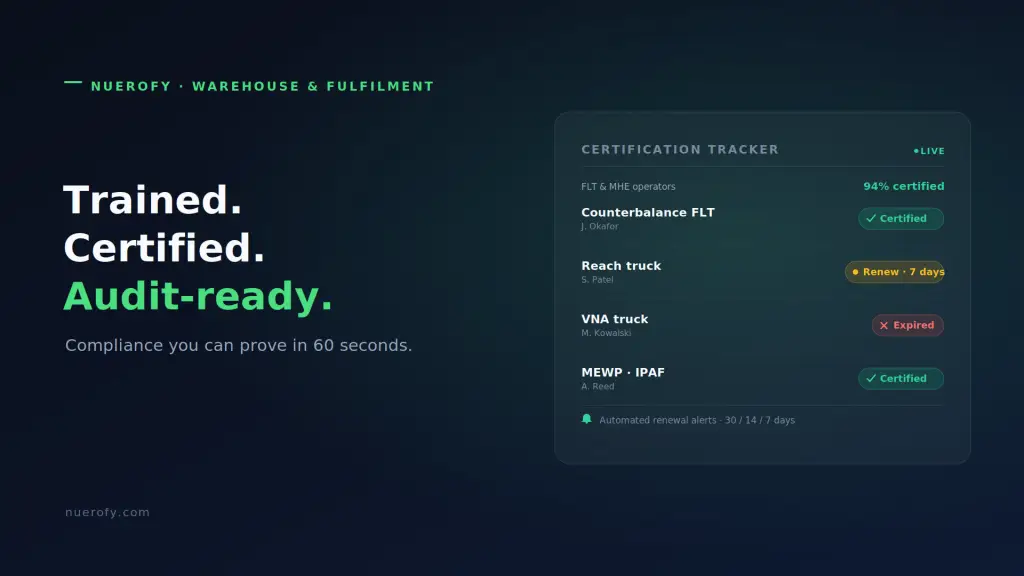
Equipment certification is the compliance category that most directly governs whether a warehouse can operate. FLT, reach truck, VNA, order picker, MEWP — each requires accredited initial training (typically RTITB or ITSSAR), site-specific conversion, and annual refresher assessment, all with documented expiry dates.
Here’s the real test: when an HSE inspector, insurer or client auditor asks which of your MHE operators are currently certified and when those certifications expire, can you answer in seconds? An operator who can is in a fundamentally stronger position than one digging through filing cabinets. The most common — and most avoidable — failure is a certification lapsing unnoticed, putting an uncertified operator on equipment and creating instant exposure.
The peak-season onboarding challenge
Peak is where good intentions meet operational reality. To deploy hundreds of temporary workers in a fortnight, each one still needs, at minimum, site H&S induction, manual handling, fire safety, PPE, pedestrian safety in vehicle environments and role-specific training — before they handle a single order.
Achieving that with classroom sessions and paper briefings isn’t realistic. It requires pre-employment digital onboarding (so temps arrive floor-ready), mobile-first delivery (so it works on a phone, on any shift, even with patchy warehouse Wi-Fi), and automated enrolment (so the right pathway is assigned the moment someone is added to the HR or agency system). Anything less leaves compliance gaps exactly when volumes — and risk — are highest.
How a modern, AI-native approach solves it
This is the gap that purpose-built Warehousing & Fulfilment workforce learning is designed to close. Rather than bolting warehouse needs onto a generic LMS, the model is built around how these operations actually run:
- Pre-employment and automated onboarding so agency and seasonal workers complete induction, manual handling and fire safety before their first shift, with role-specific pathways assigned automatically.
- Mobile-first, offline-capable delivery that fits around 24/7 shift patterns and large sites, instead of requiring a training room or a desktop.
- 50+ language AI voiceovers so a linguistically diverse workforce receives the same quality of safety training, not a watered-down version.
- Centralised certification tracking with automated 30, 14 and 7-day renewal alerts, so refresher assessments are triggered before an FLT or MHE certification lapses — and complete records for any person, team or site can be produced for an audit in under a minute.
- A multi-site compliance dashboard giving H&S managers and operations directors a real-time view of completion across every site, shift and role — surfacing gaps before they become enforcement issues.
- An AI course builder that turns a site SOP, client onboarding pack, new WMS procedure or near-miss investigation into a structured, assessed course in minutes — alongside a library of 200+ RoSPA and CPD-accredited courses kept current as HSE guidance changes.
The combined effect is that compliance becomes continuous and provable, onboarding scales to peak without cutting corners, and a lean L&D team can build site- and client-specific training at operational pace.
What “good” looks like — a quick checklist
If you’re assessing your own operation, these are the questions worth answering honestly:
- Can you produce any operative’s full training and certification record in under 60 seconds?
- Are FLT/MHE refreshers triggered automatically before expiry, not chased manually?
- Can a temporary worker be safely onboarded before their first shift, from their phone?
- Is training delivered in the languages your workforce actually speaks?
- Can you see live compliance across every site and shift in one place?
- When a client audit lands, is evidence a dashboard — or a fire drill?
If the honest answer to several of these is “no,” the risk isn’t hypothetical; it’s sitting in the gap between what you’ve trained and what you can prove.
See it built for your operation
The fastest way to understand the difference is to see your own scenarios — peak onboarding, FLT certification tracking, a multi-site audit request — running on a platform built for them. Book a demo and we’ll walk through it, or start a free trial and have real training live within days. For the full picture of the sector’s challenges and data, read the State of Warehousing & Fulfilment Training Report 2026.
Frequently asked questions
What training is legally required to work in a UK warehouse? At a minimum, role-specific health and safety training under frameworks including PUWER, LOLER, the Manual Handling Operations Regulations, the Working at Height Regulations and COSHH — covering areas such as manual handling, fire safety, PPE, pedestrian safety around vehicles, and equipment-specific certification (e.g. FLT). Requirements vary by role and site, so a site-specific induction is essential.
How is forklift (FLT) certification managed and kept current? Accredited initial training (typically RTITB or ITSSAR), site-specific conversion assessment, and an annual refresher with a documented expiry date. The key to staying compliant is tracking expiry centrally and triggering refreshers automatically before certifications lapse — rather than discovering a lapse during an audit.
How can a fulfilment centre onboard hundreds of temporary workers for peak? Through pre-employment digital onboarding, mobile-first delivery and automated enrolment, so seasonal and agency workers complete essential H&S training before their first shift and arrive floor-ready — something classroom induction can’t deliver at peak scale.
How does this help with HSE inspections and client audits? A central platform keeps tamper-resistant training and certification records that can be produced on demand, plus a real-time multi-site dashboard showing completion across every shift and role — so audit readiness is continuous rather than reconstructed under pressure.
Can training be delivered to a multilingual workforce? Yes — courses can be delivered with AI voiceovers in 100+ languages, so linguistically diverse warehouse teams receive consistent, high-quality safety and operational training.