
Toolbox Talks That Actually Work: A Practical Guide, a Free 52-Week Planner and a Ready-to-Deliver Talk
A toolbox talk is a short, informal safety briefing delivered to a work team, usually at the start of a shift, focused on one specific hazard or practice relevant to that day’s work. Ten minutes by the vans, one topic, two-way conversation, back to work. Done well, toolbox talks are the most effective routine safety intervention a site has, because they reach people at the moment and in the place the risk actually exists. Done badly, they are a laminated sheet read aloud to a cold, silent yard while a supervisor collects signatures, and everyone involved knows no learning occurred.
This guide covers what separates the two: the legal position, the mechanics of a talk that lands, a free 52-week planner so you never start a Monday wondering what to cover, a ready-to-deliver example talk to show the standard, and the honest conversation about where toolbox talks fit in a modern training system.
Are toolbox talks a legal requirement?
No regulation names them, but the duty they serve is statutory: the Health and Safety at Work Act requires employers to provide the information, instruction, training and supervision needed to protect their people, and the Management Regulations require that to be kept current with the risks. On construction sites, CDM expectations and principal-contractor regimes make regular safety briefings effectively unavoidable, and HSE inspectors routinely ask how safety information reaches the workforce between formal courses. Toolbox talks are the industry’s standard answer. The legal catch is the one most sites miss: an unrecorded talk is, for evidential purposes, a talk that never happened. If the signature sheet from the March briefing on ladder pre-checks cannot be produced after a fall in August, the briefing contributes nothing to the defence. The duty is not just to talk; it is to be able to show who was told what, and when.
The anatomy of a talk that lands
Four rules separate talks that change behaviour from talks that fill a folder:
- One topic, ten minutes. A talk covering three subjects teaches none of them. Pick the single hazard most relevant to today’s work and stop while attention is still alive.
- Make it theirs, not generic. “Manual handling” is a category; “the kerb stones arriving on Thursday weigh 38kg each” is a toolbox talk. The best material starts from this site, this week.
- Two-way or it did not happen. Ask what near-misses people have seen, what makes the safe method awkward, what kit is missing. The questions are the talk; the sheet is just the prompt.
- Record it properly. Topic, date, deliverer, named attendees, and ideally the questions raised, because that record is the evidence the whole exercise exists to create. The discipline that makes all four sustainable is planning: sites that schedule topics a year ahead deliver consistently, while sites that improvise each Monday drift into repetition and then into silence.
Download: the free 52-week toolbox talk planner
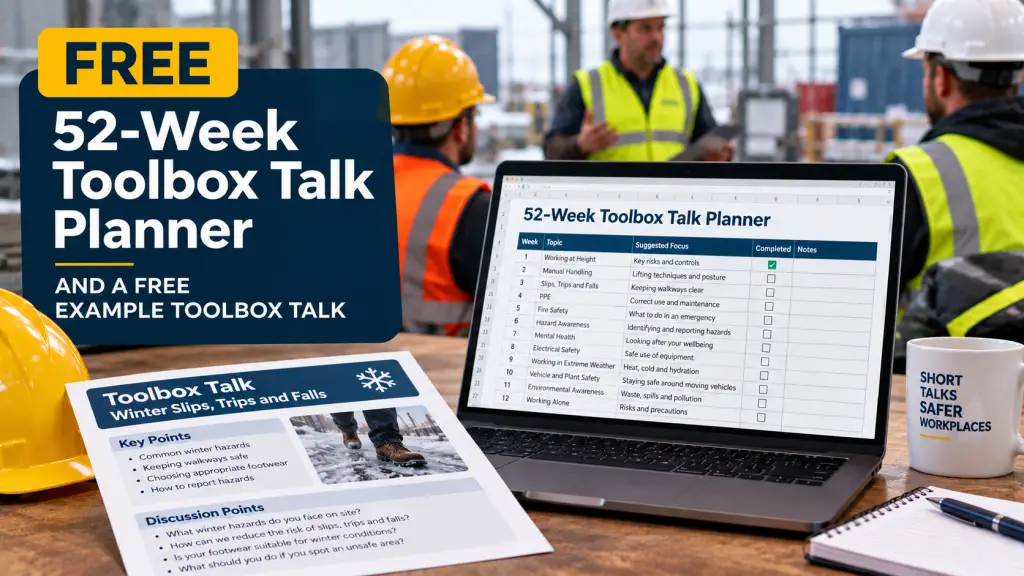
Our free planner lays out a full year of weekly topics, seasonally mapped: winter weeks carry slips on ice, winter driving and cold stress; summer carries heat, hydration and UV; year-round staples such as manual handling, working at height, PPE, COSHH, fire points and forklift-pedestrian segregation recur at sensible intervals. Every row has space for who delivered it, when, and a sign-off, so the planner doubles as your evidence index. Edit the topics to your own risk profile; the point is never to improvise again.
Download the free 52-week toolbox talk planner (Excel)
Download: a ready-to-deliver example talk
To show the standard, we have also made one talk fully ready to deliver: Slips, Trips and Falls in Winter Conditions, seasonal for the months ahead and relevant to almost every site. It follows the structure above: a one-line purpose, five key points in plain language, prompts to localise it to your site, the questions to ask the team, and an attendance record on the same sheet. Print it, deliver it in ten minutes, file the signed copy.
Download the example toolbox talk (Word)
Both files are free, ungated and unbranded inside. Use them as they are or as the pattern for your own.
Where toolbox talks fit in 2026
Now the honest part. Toolbox talks are necessary and irreplaceable for site-specific, same-day risk, and nothing digital should remove the supervisor standing in front of the team. But as a site’s only routine training mechanism they have structural limits: night shifts and weekend contractors miss them, non-native speakers nod through them, the paper record lives in a cab until it does not, and the same five topics rotate while the other forty-seven never arrive. The sites handling this best run a hybrid: the live talk for today’s specific risk, backed by short, mobile, assessed modules for the systematic estate, delivered through a health and safety training platform that reaches every shift in 100+ languages and records completion automatically. The two reinforce each other: this week’s toolbox talk sheet becomes a five-minute assessed module in the AI Studio in minutes, so the workers who missed Monday’s huddle still get Monday’s message, with evidence attached, and the annual estate behind the talks runs on the cycles in our health and safety training library. For how this plays out in a production environment, our article on manufacturing and production training covers the shift-coverage problem in depth.
If your talks are solid but your evidence is a folder of damp signature sheets, book a demo and we will show you a toolbox talk converted into a tracked, multilingual module live during the session.
Frequently asked questions
What is a toolbox talk? A short, informal safety briefing, typically five to fifteen minutes, delivered to a work team on a single hazard or safe practice relevant to their current work, usually at the start of a shift and at the place of work. The name comes from crews gathering around the toolbox.
Are toolbox talks a legal requirement in the UK? Not by name, but they are the standard way sites meet the statutory duty to provide information, instruction and training and to keep it current with the risks, and on construction sites regular briefings are an effective expectation under CDM regimes. The record matters as much as the talk: evidencing who attended which briefing is what gives the talk legal value.
How long should a toolbox talk be? Five to fifteen minutes, on one topic. Longer sessions become training courses delivered badly; the format works because it is short, specific and conversational.
How often should toolbox talks be delivered? Weekly is the most common rhythm, with daily briefings on fast-moving or high-risk sites. The sustainable pattern is a planned annual cycle of topics, adjusted for the season and the week’s actual work, rather than improvised repetition.
What topics make good toolbox talks? Whatever is most relevant to this week’s work, drawn from a planned year: manual handling, working at height, ladder checks, PPE, COSHH, fire points, housekeeping, forklift and pedestrian segregation, lone working, hand-arm vibration, and seasonal subjects such as winter driving, ice, heat stress and UV. Our free 52-week planner maps a full year.
Do toolbox talks need to be recorded? Yes, if they are to count for anything beyond the moment: topic, date, deliverer and named attendees at minimum. An unrecorded talk cannot be evidenced to an inspector, insurer or tribunal, which is why many sites now pair live talks with digital modules that record completion automatically.