
Most industries get notice before an inspection. The best-performing food manufacturers don’t. Under BRCGS Global Standard for Food Safety Issue 9, sites holding the coveted AA and A+ grades are audited unannounced — an auditor can walk through the door on any production day and ask for evidenced training records for every person in scope. Add retailer factory-assurance visits, FSA investigations and, in the worst cases, a coroner’s inquest after an allergen failure, and the conclusion is unavoidable: in food and beverage manufacturing, training governance can’t be prepared for the audit. It has to be the audit-ready state, every single day.
And this is no niche concern. Food and drink is the UK’s largest manufacturing sector, employing 486,500 people across 12,195 businesses, contributing £37 billion to the economy and accounting for 24.2% of total UK manufacturing turnover — while carrying a vacancy rate of 3.9%, nearly double the 2.1% of wider manufacturing (FDF, 2025). This guide sets out why training in this sector is uniquely demanding and what always-audit-ready looks like in practice. The data throughout draws on our State of Food & Beverage Manufacturing Training Report 2026, worth reading in full if you own technical, quality or L&D in a food business.
Training isn’t best practice here — it’s food law
Start with the legal position, because it’s stronger than most sectors realise. The Food Safety Act 1990 and the Food Hygiene (England) Regulations 2006 require food business operators to ensure all staff involved in food handling are appropriately supervised, instructed and trained — a duty enforced by the Food Standards Agency, local authority environmental health officers and Trading Standards. Allergen management failures have led to criminal prosecution and coroner’s inquests, and Natasha’s Law added pre-packed-for-direct-sale labelling obligations with direct training implications for packing and despatch teams. Every one of the sector’s 486,500 workers must be trained to handle food safely — and the business must be able to prove it.
Why food manufacturing training is harder than almost anywhere else
Three forces combine to make this one of the most demanding learning environments in British industry.
- Food safety law and regulatory enforcement. A legally mandated training baseline for every food handler, actively enforced — with allergen failures carrying criminal and reputational consequences that few other training gaps can match.
- Retailer standards and certification. BRCGS requires evidenced training for all employees in scope with unannounced audits at the top grades; retailers run their own factory-assurance audits and increasingly specify digital training governance as a condition of supplier approval. Lose the certification and you lose the listings.
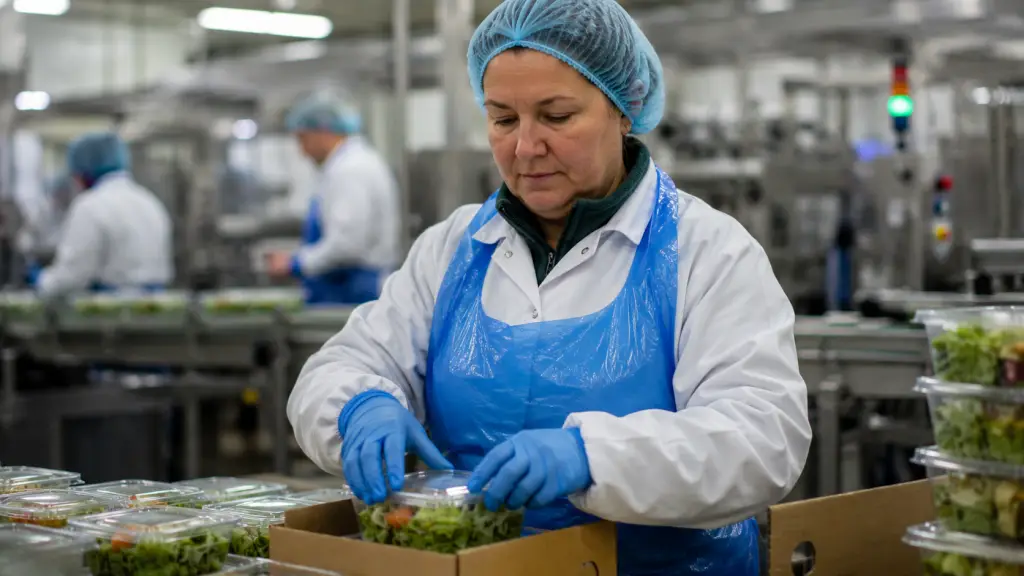
- A high-churn, multi-shift, multilingual workforce. Vacancies at 3.9%, two- and three-shift patterns as standard, heavy agency intake, and production teams among the most linguistically diverse in UK manufacturing — a site may onboard 20–50 new operatives every month. Individually each would stretch any L&D function; together they demand training that is legally solid, always evidenced, and deliverable at the pace of a 24/7 production line.
The compliance foundation every food handler needs
Before anyone touches product, a legally mandated baseline has to be in place, evidenced and refreshed. For all production staff it spans:
- Food safety and hygiene (Level 2) — the mandated baseline for all food handlers: contamination prevention, personal hygiene, HACCP principles and reporting obligations.
- Allergen awareness — the 14 major allergens, cross-contact risk, Natasha’s Law labelling implications, and the consequences of allergen failure.
- Contamination controls — foreign body prevention (glass and hard plastic control, metal detection awareness), personal hygiene protocols, and pest control awareness.
- Cleaning, chemicals and cold chain — COSHH for food-grade chemicals, correct dilutions and contact times, plus temperature monitoring and deviation response for chilled and frozen environments. Every category refreshes annually or on defined cycles — which is precisely where paper sign-off sheets in site folders quietly become an audit non-conformance.
Our reference guide to UK training renewal periods sets out the accepted cycle for each subject and where the legal requirement ends and industry practice begins.
HACCP and the retailer layer: where contracts are won and lost
Legal compliance is the floor. What determines whether a manufacturer wins and keeps retailer listings is the technical layer above it: HACCP team competence (hazard analysis, CCP identification and validation, monitoring, corrective action), GMP standards, internal audit capability, supplier management awareness and continuous improvement (root cause analysis, CAPA). BRCGS Issue 9 requires documented training evidence for all of it, with records available for audit — and crucially, CCP monitoring training can’t stop at the food safety team. Every operative monitoring a critical control point needs to understand why it matters, what the critical limits are and what to do when a deviation occurs, with evidence exportable by line, shift and date. When a retailer updates its code of practice, that’s a training event too — and you need proof your teams understood the change.
The onboarding engine: 20–50 new operatives a month
The operational reality of food manufacturing turns training into a continuous production process of its own. Three shifts, seven days, regular agency intake and structural churn mean classroom induction simply cannot keep pace. What can: automated enrolment (a new starter’s full pathway — food safety, allergens, H&S, manual handling, site procedures — assigned on day one), mobile-first delivery accessible from a phone in the welfare area on any shift, and training in the languages your production floor actually speaks. If a significant share of the workforce is more comfortable in Polish, Romanian or another language, English-only training is a food safety risk, a legal risk and an audit risk all at once.
Multi-site, multi-allergen, one source of truth
Most substantial food manufacturers run several sites — each with its own HACCP plan, allergen profile, BRC certificate, shift patterns and retailer requirements. Without a centralised platform, training records fragment across site folders and spreadsheets: invisible to the group technical director and indefensible in a group-level audit or FSA investigation. The structure that works is a shared compliance library across the group, a site-specific layer for each factory (its allergen map, CCP protocols, hygiene procedures and emergency contacts), agency workers and contractors managed in the same system as direct staff, and a group dashboard showing live completion by site, shift and individual — extendable to key suppliers and co-manufacturers through their own training portals.
How a modern, AI-native approach solves it
This is the gap purpose-built Food & Beverage Manufacturing workforce learning is designed to close. Rather than stitching together sign-off sheets and spreadsheets, a modern AI-powered learning platform brings food safety compliance, technical training and audit evidence into one always-ready system:
- 200+ RoSPA and CPD-accredited courses in our Learning Library — Food Safety Level 2, Allergen Awareness, HACCP Principles, COSHH, Manual Handling, Fire Safety and more — updated as FSA guidance and food law evolve, with the full compliance training estate managed in one place.
- Automated annual refresher workflows — food safety, allergen and hygiene training re-assigns itself before certification lapses, with 30/14/7-day alerts to the operative, their line manager and the quality team.
- An AI course builder that converts your HACCP plans, allergen risk assessments, cleaning schedules and customer codes of practice into structured, assessed training in minutes — so a site-specific allergen module, a CCP monitoring course or new-product-launch training deploys on the day it’s needed, not weeks later.
- Multi-shift, mobile-first onboarding with automated enrolment and digital certificates from the first shift — compressing a half-day classroom induction into under an hour, from any device, at any time.
- 100+ language AI voiceovers so every operative on every shift receives food safety training in the language they genuinely understand.
- BRC- and retailer-audit-ready reporting — a complete, timestamped training evidence report for any site, production area or certification category in under 60 seconds, with HACCP training traceability by line, shift and date, and allergen-specific evidence for everyone handling allergen-containing materials. The result is a business that doesn’t scramble when the unannounced audit arrives — because the audit-ready state is simply how training runs every day.
What “good” looks like — a quick checklist
If you’re assessing your own operation, answer these as a BRC auditor would:
- If an unannounced audit happened tomorrow, could you produce a complete, evidenced training record for every person in production within 30 minutes?
- Do Level 2 food hygiene, allergen awareness and annual refreshers re-enrol automatically before they lapse?
- Does every site have allergen training built from its own allergen map and changeover procedures?
- Can every operative monitoring a CCP evidence training on that specific control point?
- Do agency starters complete induction from a phone before their first shift — in their strongest language?
- Can group leadership see live training compliance across every site without phoning site managers? If several answers are “no,” the exposure isn’t hypothetical — it’s a non-conformance waiting for an audit date you won’t be given.
See it built for your operation
The fastest way to grasp the difference is to see your own scenarios — an unannounced BRC audit request, a new product launch with a new allergen profile, a monthly agency intake — running on a platform built for food manufacturing. Book a demo and we’ll walk through it, or start a free trial and have real training live within days. For the full picture of the sector’s challenges and data, read the State of Food & Beverage Manufacturing Training Report 2026.
Frequently asked questions
What food safety training is legally required in food manufacturing? The Food Safety Act 1990 and Food Hygiene (England) Regulations 2006 require all staff involved in food handling to be appropriately supervised, instructed and trained. In practice that means Level 2 food safety and hygiene for all food handlers, allergen awareness, personal hygiene and contamination-control training, COSHH for cleaning chemicals and, where relevant, cold chain and temperature-control training — all refreshed on defined cycles and evidenced.
What training does BRCGS Issue 9 require? BRCGS Global Standard for Food Safety Issue 9 requires documented training evidence for all employees in scope, regular assessment of training needs, and records available for audit — including HACCP team training, GMP, internal audit competency and supplier management awareness. Sites at AA and A+ grades receive unannounced audits, so training governance must be inspection-ready at all times.
How should HACCP training extend to production operatives? Beyond the HACCP team, every operative monitoring a critical control point should be trained on why the CCP matters, its critical limits, monitoring procedures and deviation response — with training evidence traceable and exportable by line, shift and date for audit.
How do you onboard 20–50 new production operatives a month? Through automated enrolment (the full induction pathway assigned on day one), mobile-first delivery accessible on any shift from a phone or shared device, and AI voiceovers in the languages the workforce actually speaks — compressing classroom induction into under an hour with a digital, auditable record from the first shift.
How does allergen training relate to Natasha’s Law? Natasha’s Law (the UK Food Information Amendment Regulations, in force since 2021) requires full ingredient and allergen labelling on pre-packed-for-direct-sale food — creating specific training needs for packing and despatch teams on labelling procedures, alongside broader allergen awareness covering the 14 major allergens and cross-contact risk across production.
Can training records cover multiple sites and agency staff in one place? Yes — a centralised platform holds a single, timestamped record for every worker (direct, agency or contractor) across every site, with a group dashboard for live compliance visibility and audit-ready evidence exportable for any site, production area or training category in under a minute.