
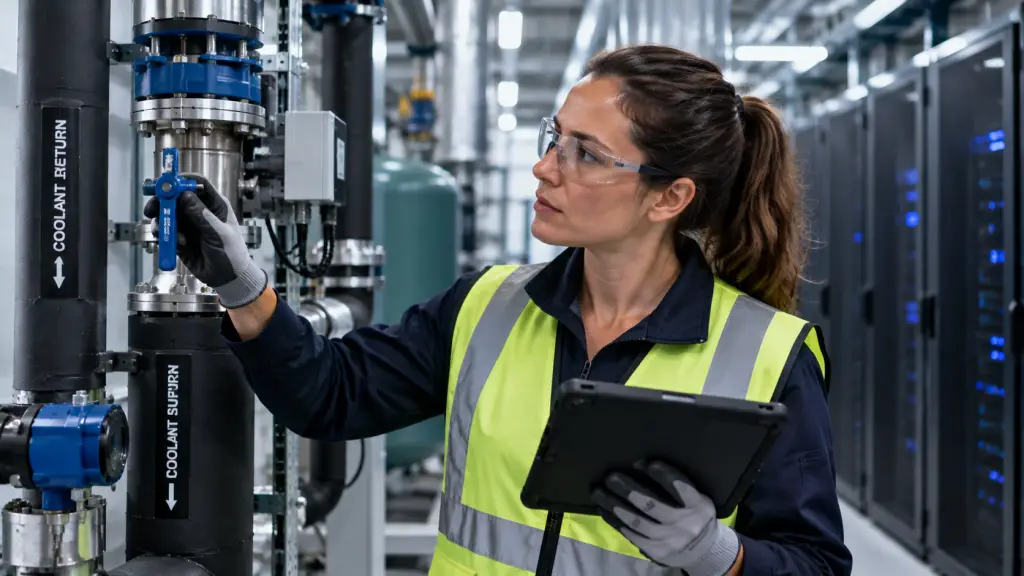

When Water Enters the White Space: Liquid Cooling and the New Data Centre Training Estate
Every data centre technician learned the same first commandment: keep liquids away from the electronics. It shaped the room itself, from raised floors and leak detection at the perimeter to the strict choreography of anything wet entering the hall. And now, deliberately and at industrial scale, the industry is reversing it. Coolant loops are being plumbed directly onto the hottest silicon on earth, coolant distribution units are joining UPS systems on the critical equipment list, and the fluid the old rules existed to exclude is becoming the thing that keeps the facility alive.
The numbers say this is no longer a niche experiment. The Uptime Institute found 19% of data centres had adopted liquid cooling by early 2026, with a further 36% planning adoption within 12 to 24 months, and Goldman Sachs forecasts that 76% of AI servers shipped in 2026 will be liquid-cooled, up from 15% just two years earlier. The driver is simple physics: AI racks now routinely draw 80 to 120 kW against air cooling’s practical ceiling of roughly 40 kW, NVIDIA’s Blackwell-class chips pull around 1,000 watts each, and projections point to racks of 200 kW and beyond. What gets far less attention is the sentence Uptime attaches to its own adoption data: operational complexity is what limits broader rollout. Strip the euphemism away and that is a people problem. The hardware is ready; the workforce, the procedures and the training estate mostly are not. This article looks at what changes when water enters the white space, drawing throughout on our State of Data Centre Training Report 2026.
The room is changing faster than the rulebook
The first thing to understand is that this transition rarely happens cleanly. Almost no operator flips an entire facility to liquid; the standard pattern is hybrid, with a handful of high-density AI rows running direct-to-chip cooling inside a hall that remains air-cooled everywhere else. That sounds manageable until you consider what it means operationally: two thermal regimes, two sets of failure modes and two bodies of procedure coexisting in one room, worked by the same shift team on the same night. A technician can walk ten metres and cross from an environment their whole training prepared them for into one it never mentioned. Hybrid operation is not a transitional inconvenience. For most facilities it will be the operating reality for a decade, and the training estate has to cover both regimes at once.
A new hazard class: fluid meets voltage
Liquid cooling imports an entire category of hazard the traditional data centre curriculum simply does not contain. Water-glycol mixes and dielectric fluids now circulate under pressure through quick-disconnect couplings centimetres from live electrical distribution. That creates genuinely new training obligations:
- Leak detection and response as a first-class emergency category, with its own escalation paths, isolation steps and spill procedures, drilled like any other EOP rather than improvised on the night.
- Pressurised system safety covering loop pressures, quick-disconnect handling under power, filling, venting and draining procedures, and the failure modes of hoses, manifolds and couplings.
- Fluid chemistry and COSHH for glycol concentrations, corrosion inhibitors, biocides and dielectric fluids, including the vapour considerations that arrive with two-phase systems.
- CDU operations and maintenance, because coolant distribution units now sit on the critical path alongside UPS and generators, with their own alarms, redundancy logic and maintenance regimes. Every item on that list sits squarely inside the same legal estate as the rest of the facility’s health and safety training, from COSHH to PUWER, and every item needs to be trained, assessed and evidenced per individual before the first loop is pressurised, not after the first incident report.
Procedures written for a different room
The deeper problem is procedural. A data centre’s resilience lives in its EOPs, SOPs and MOPs, and the Uptime Institute’s outage analyses have found for years that the majority of incidents involve human error, most often procedures not followed or procedures that no longer matched the room. Liquid cooling invalidates chunks of that library at a stroke. What does the emergency response look like when the leak alarm is inside the rack rather than under the floor? What is the safe isolation sequence when thermal runaway on a 100 kW rack gives you minutes, not hours, of thermal headroom? Which steps of the old maintenance MOP survive when the server tray now has coolant lines that must be disconnected first? Operators deploying liquid cooling are, whether they frame it this way or not, rewriting their procedural core, and every rewritten procedure is a training event: built, deployed to every affected technician on every shift, assessed and evidenced before the change goes live.
The competence gap arrives on a truck
Here is the practical bind for 2026 and 2027. Liquid-cooled AI infrastructure arrives on a delivery schedule set by chip vendors and anxious clients, not by the maturity of the operator’s training programme. A GB200-class rack turns up as a sealed, liquid-cooled unit with manufacturer-specific loops, fluids, alarms and service procedures, and the facility team is expected to operate it safely from commissioning day. There is no established college course producing liquid-cooling technicians, and the specialist knowledge currently lives with the OEMs and a thin layer of early adopters. The operators handling this well borrow the discipline the energy sector calls trained before energised: the manufacturer’s manuals, commissioning documents and the site’s own fluid procedures are converted into structured, assessed modules before the hardware is powered, using an AI Studio approach that turns a service manual into a course in minutes rather than commissioning content over a quarter. The training ships with the rack, or the rack waits.
New trades at the door
Liquid cooling also changes who walks into the white space. Alongside the familiar rotation of electrical and mechanical vendors, operators are now inducting pipework specialists, fluid-handling contractors and OEM cooling engineers, trades whose site instincts were formed on plant rooms rather than raised floors. They need the standard induction every contractor gets, plus the liquid-specific layer: this hall’s leak response, its isolation points, its rules for working on pressurised loops adjacent to live racks. And the same evidential standard applies in reverse to the operator’s own team, whose competence records must now show liquid-cooling modules alongside the electrical and procedural ones, because a client audit or an incident investigation will ask for exactly that, per named individual, with dates.
Ready before the coolant flows
Pull the threads together and the requirement is clear. The liquid transition needs a training estate that can absorb a new hazard class quickly, rewrite and redeploy procedures at the pace of the hardware roadmap, cover a hybrid room’s double curriculum, extend to new contractor trades, and evidence all of it to auditors and regulators. In practice that means modern employee training software doing what spreadsheets and binder-based procedures cannot: converting OEM manuals and site procedures into assessed modules in minutes, assigning them by role and by row, reaching 24/7 shifts on mobile in 100+ languages, automating refreshers with 30, 14 and 7-day alerts, and exporting a complete competence record for any technician or contractor in under a minute. That capability sits at the heart of our Data Centre Workforce Learning offer, alongside the onboarding, contractor governance and audit evidence the rest of this series has covered.
The industry has decided that water belongs in the white space. The operators that thrive will be the ones whose people were ready before the coolant flowed. If liquid cooling is on your roadmap, book a demo and we’ll build a liquid-cooling module from one of your own OEM documents, live, during the session.
Frequently asked questions
What new training does liquid cooling require in a data centre? A new hazard and competence layer on top of the existing estate: leak detection and emergency response, pressurised loop safety including quick-disconnect handling, fluid chemistry and COSHH for glycol mixes and dielectric fluids, CDU operation and maintenance, and rewritten EOPs, SOPs and MOPs for every affected system, all assessed and evidenced per individual.
Why is liquid cooling adoption described as an operational challenge? Because the constraint is rarely the hardware. The Uptime Institute reports 19% adoption by early 2026 with operational complexity limiting broader rollout: hybrid rooms running two thermal regimes, procedures that no longer match the environment, and a workforce whose training predates the technology.
Do hybrid facilities need two sets of training? Effectively yes. Most operators run liquid-cooled AI rows inside otherwise air-cooled halls, so the same shift team needs current competence in both regimes, with role-based pathways covering the traditional estate and the liquid-specific layer together.
How should operators train for manufacturer-specific liquid-cooled racks? By converting each OEM’s manuals, commissioning documents and service procedures into structured, assessed modules before the hardware is energised, so site teams are trained on the specific loops, fluids and alarms they will operate rather than on generic content, with completion evidenced ahead of go-live.
Are contractors affected by the liquid cooling transition? Yes. Pipework, fluid-handling and OEM cooling specialists are new trades entering the white space, and they need the standard site induction plus a liquid-specific layer covering leak response, isolation points and rules for working on pressurised loops near live equipment, evidenced per person per visit.
How does liquid-cooling training fit audit and regulatory evidence? Identically to the rest of the estate. Client audits, ISO 27001 and SOC 2 reviews, and the incoming essential-services regime all turn on evidenced competence, so liquid-cooling modules, procedure updates and contractor inductions should sit in the same system as everything else, exportable per named individual in under a minute.