
The Employee Induction Checklist: What to Cover, Why Most Inductions Fail, and a Free Template
An induction is the structured process of turning a new starter into a safe, legal, functioning member of the team: the information they must receive, the training they must complete and the introductions they need, sequenced from before day one through their first month. Every employer runs one, because even “here’s your desk, ask if you need anything” is an induction, just a bad one. The difference between good and bad inductions is rarely effort; it is structure and evidence, which is exactly what a checklist provides and why “induction checklist” is one of the most searched phrases in UK HR.
This guide covers what an induction must legally include, what the good ones add, the full checklist phase by phase with a free template to download, and the honest reasons most inductions fail even when the checklist gets signed.
Induction or onboarding? A useful distinction
The terms blur, but the practical split is this: induction is the structured, largely compliance-driven process of the first days and weeks, the things that must happen, in order, with a record. Onboarding is the longer arc of making someone effective and committed, running through probation and beyond. The induction is a subset of onboarding, and it is the subset with legal weight, which is why it deserves its own checklist rather than dissolving into a vague “settling in” period.
What an induction must legally cover
No regulation prescribes an induction by name, but several duties can only realistically be met through one, and they anchor day one. Health and safety law requires employers to provide the information, instruction and training needed to work safely, and for a new starter that is immediate: fire evacuation and assembly points, first aid arrangements, accident and near-miss reporting, the specific hazards of the site and role, and any PPE before exposed work begins. New and inexperienced workers are a known risk concentration, with HSE guidance repeatedly noting that workers are far more likely to be injured in their first six months, which makes the induction itself a risk control, not an admin exercise. Add the employment essentials with their own clocks, right-to-work checks before work starts and the written statement of particulars due by day one, and the legal spine of the checklist writes itself. Everything else, culture, systems, introductions, is what good employers add on top.
The checklist, phase by phase
A proper induction runs in four phases, and the free template below carries the full item list for each:
- Before day one: contract and right-to-work completed, IT accounts and access requested, uniform or PPE ordered, the team told someone is coming, and a welcome message so the starter knows where to be and what to bring. Pre-boarding is also where digital training shines: policies and compliance modules completed before arrival turn day one from a reading marathon into a working day.
- Day one: the legal spine first (fire, first aid, accident reporting, site hazards, security and signing in), then the human essentials: tour, introductions, line manager time, welfare facilities, and the immediate training the role cannot start without.
- Week one: core role training, systems access confirmed and used, key policies covered properly rather than signed blind (conduct, harassment reporting, data protection), DSE setup for desk-based roles, and a buddy or manager check-in that actually happens.
- First month: probation objectives agreed, all mandatory training completed and evidenced, outstanding kit resolved, a two-way feedback conversation, and a signed first-month review closing the induction formally. Each item in the template carries who is responsible, a completion date and initials, because an induction without a record is an induction you cannot prove happened, and tribunals, insurers and inspectors ask for exactly that proof after something goes wrong in an employee’s early months.
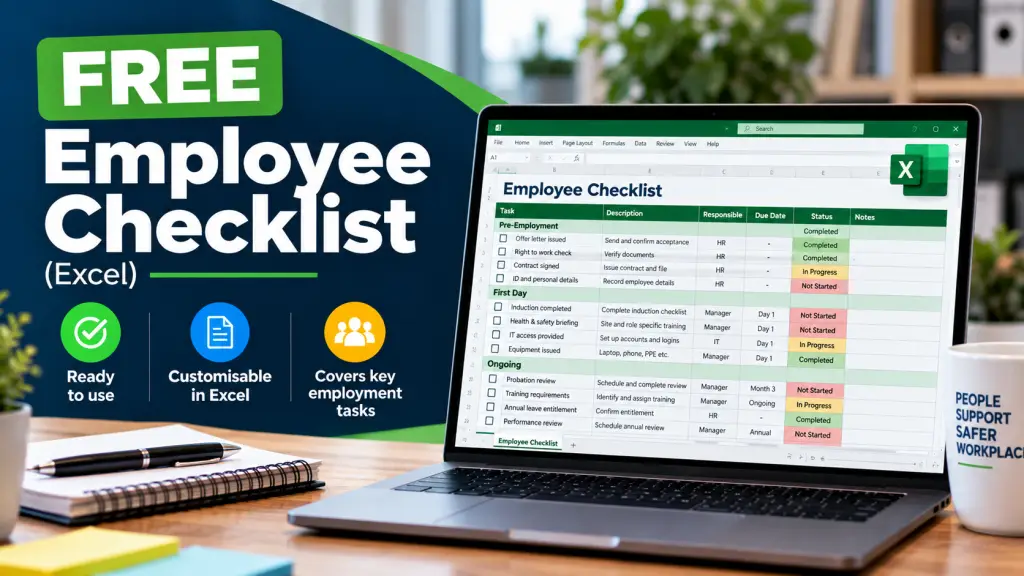
Download the free induction checklist template
Our free template covers all four phases with around thirty pre-filled items, editable to your organisation: a header block for the starter’s details, columns for who covers each item, completion dates and initials, and a live count of items completed so the induction’s status is visible at a glance. It works in Excel and Google Sheets, with no macros and no email gate.
Download the free induction checklist template (Excel)
Why inductions fail even when the checklist is signed
Most induction failures share a shape, and it is worth naming them because the checklist alone fixes none of them. The firehose problem: day one delivers eight hours of information to a person who, by the forgetting curve, will lose most of it within a week, which is why front-loading everything into one day produces signatures rather than knowledge. The assessment gap: telling is not training, and without a few questions at the end nobody knows whether the fire procedure landed or washed past. The record gap: paper checklists live in drawers, get part-completed, and surface blank at exactly the wrong moment. And the scale problem: a checklist managed by one person works for one starter a month and collapses during a seasonal intake of forty, which is precisely when new-worker risk peaks. None of these are people failures; they are format failures, and they have a format solution.
The modern induction: structured, assessed, evidenced
The fix is to move what can move into short digital modules and keep the human parts human. On a modern staff induction software platform, the compliance spine becomes mobile modules completed before or on day one, assessed so understanding is tested rather than assumed, in 100+ languages for international teams, with every completion timestamped per named individual automatically. Site tours and welcomes stay face to face, or become consistent, rewatchable video inductions, an approach we covered fully in our piece on video inductions. New starters inherit their role’s full pathway the day they are added, the checklist becomes a live dashboard, and the first-month review draws on a complete record rather than memory. It is the same philosophy as the template, industrialised, and it is the core of our employee onboarding work: structure plus evidence, at any intake volume.
Use the template as it stands if your intake is steady and small. If forty starters are arriving for peak, book a demo and we will show you the same checklist running itself.
Frequently asked questions
What should an employee induction include? The legal spine on day one (fire evacuation, first aid arrangements, accident reporting, site and role hazards, PPE where needed), the employment essentials (right to work completed, written particulars provided), then structured role training, key policies, systems access and introductions across the first week, closing with completed mandatory training and a review in the first month.
Is an induction a legal requirement in the UK? Not by that name, but the duties it delivers are legal requirements: health and safety information, instruction and training must be provided before risks are faced, right-to-work checks must precede work, and the written statement of particulars is due by day one. An induction is simply the structured way of meeting them, and the record it creates is the evidence.
How long should an induction take? The legal spine must land on day one, but a good induction runs about a month: essentials first, role training across week one, and completion, feedback and review by the end of month one. Compressing everything into one day produces signatures, not understanding.
What is the difference between induction and onboarding? Induction is the structured, compliance-led process of the first days and weeks; onboarding is the longer journey to full effectiveness, running through probation and beyond. The induction is the part with legal weight and therefore the part that needs a checklist and a record.
Do seasonal and temporary staff need a full induction? They need the full legal spine from their first shift, since the law does not distinguish by contract length, plus the role training their work requires. High-volume seasonal intakes are where paper inductions fail most, and where digital pre-boarding with automatic records earns its keep.
Should inductions be assessed? Yes. A short assessment after each element is the difference between information delivered and information received, and an assessed completion is far stronger evidence than a signature on a sheet if the induction is ever examined after an incident.