
Modern learning platforms have evolved dramatically over the past few years. Modern platforms like Sana have helped redefine what organisations expect from digital learning by introducing sleek user experiences, AI-powered functionality, and highly polished interfaces.
However, as more businesses explore modern learning systems, a different conversation is starting to emerge. The challenge is no longer simply finding a capable platform. It is finding one that can deliver value quickly, without complex setup and configuration.
The Hidden Reality of Enterprise Learning Platforms
One of the biggest misconceptions in the learning technology space is that implementation is quick simply because a platform looks modern.
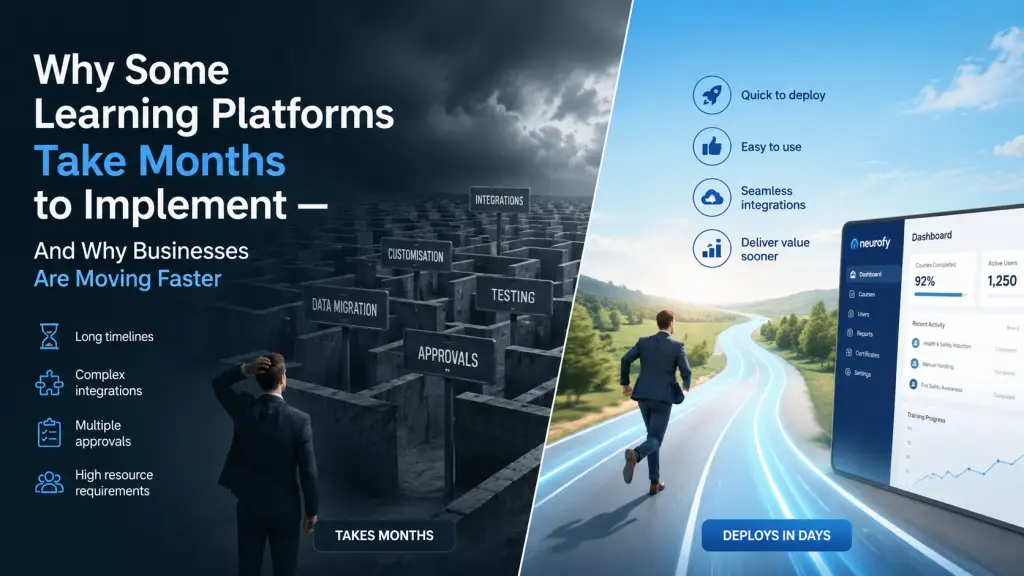
In reality, even highly polished legacy LMS systems can require significant time and planning before they are fully operational. This is particularly true for enterprise-focused platforms, where flexibility and scalability often come hand in hand with increased complexity.
Organisations frequently underestimate the amount of work involved.
Before training even begins, businesses may need to:
- Structure learning environments
- Configure permissions and hierarchies
- Build learning paths
- Import users and content
- Align branding and workflows
- Integrate with existing systems
For larger organisations, this can extend into weeks or even months of implementation work.
The result is that many businesses invest in a platform expecting immediate transformation, only to find themselves stuck in prolonged setup phases before seeing any real impact.
Complexity Often Grows Over Time
Another challenge with highly configurable systems is that complexity tends to increase as the platform evolves internally.
What starts as a clean implementation can gradually become more layered as:
- Teams add new processes
- Additional permissions are introduced
- More content structures are created
- Reporting requirements expand
Over time, this can create a system that feels heavier to manage than originally expected.
This does not mean the platform is flawed. In many cases, it reflects the reality of enterprise software. Platforms designed to support highly complex organisations inevitably inherit some of that complexity themselves.
But for many businesses, particularly growing companies or leaner teams, this can create friction that slows down learning rather than accelerating it.
A Different Approach: Faster, Leaner, More Practical
This is where Neurofy takes a fundamentally different approach.
Rather than building around heavy implementation processes, Neurofy is designed to minimise friction from the very beginning. The focus is on getting organisations operational quickly, with as little setup overhead as possible.
The philosophy is simple:
A learning platform should help organisations move faster, not slow them down.
Instead of requiring long deployment cycles, Neurofy is built to allow businesses to:
- Create courses rapidly
- Roll out training quickly
- Adapt content instantly
- Scale naturally over time
This dramatically reduces the time between purchasing a platform and actually delivering value through it.
Fast Setup Without Sacrificing Capability
There is often an assumption that faster implementation means fewer features. Traditionally, simpler systems achieved speed by sacrificing depth.
Modern platforms no longer need to make that compromise.
Neurofy focuses on delivering the capabilities organisations use most frequently — AI-powered course creation, intuitive learning management, streamlined reporting, and scalable user management — without burying them beneath layers of complexity.
The result is a platform that feels significantly lighter operationally, while still delivering the modern functionality businesses now expect.
For many organisations, this creates a more practical balance between capability and usability.
Why Simplicity Matters More Than Ever
In today’s environment, speed and adaptability are becoming increasingly important.
Businesses need to respond quickly to:
- Regulatory changes
- New internal processes
- Evolving technologies
- Skills shortages
- Operational risks
If creating or updating training becomes slow, the platform itself can become a bottleneck.
This is why simplicity is no longer just a design preference. It is becoming a strategic advantage.
A platform that is easier to use:
- Gets adopted faster
- Requires less admin overhead
- Encourages more content creation
- Keeps learning current and relevant
In practice, this often delivers more value than having the largest possible feature set.
The Importance of Transparent Pricing
Another area where businesses are becoming more cautious is pricing structure.
Enterprise learning platforms frequently involve:
- Custom pricing
- Feature-based licensing
- Additional onboarding costs
- Scaling fees
While this may suit very large organisations, it can create uncertainty for businesses trying to plan growth and control operational costs.
Neurofy takes a more transparent approach. The focus is on predictable pricing structures that align with how organisations actually use the platform, rather than layering additional costs as usage grows.
This allows businesses to scale more confidently without worrying about hidden complexity or escalating licensing models.
Built for Modern Teams, Not Just Enterprise Structures
The learning platform market has historically focused heavily on enterprise organisations with large internal L&D departments.
But the reality is that many modern businesses operate very differently. Teams are leaner, faster-moving, and often expected to manage learning alongside multiple other responsibilities.
Neurofy is designed with this environment in mind.
The platform prioritises:
- Ease of use
- Fast deployment
- Minimal training overhead
- Quick course creation
- Clean, intuitive workflows
This allows organisations to focus more on delivering learning and less on managing the system itself.
The Market Is Shifting Towards Efficiency
The broader learning technology market is beginning to reflect this change in priorities.
Organisations are no longer simply asking:
“What is the most powerful platform?”
They are increasingly asking:
“What is the most efficient platform for how we actually work?”
That distinction matters.
Because in many cases, businesses do not need more complexity. They need:
- Faster execution
- Better usability
- Lower operational overhead
- More flexibility
- Faster return on investment
This is exactly the space Neurofy is designed to address.
Final Thoughts
Platforms like Sana have played an important role in modernising the learning technology landscape. They have demonstrated what modern learning experiences can look like and helped push the industry forward.
But as the market matures, organisations are becoming more pragmatic in how they evaluate platforms.
The focus is shifting away from simply acquiring the most feature-rich system and towards finding platforms that are:
- Faster to implement
- Easier to manage
- More cost effective
- Better aligned with real operational needs
Neurofy reflects this new direction.
It delivers a modern, AI-powered LMS/LXP without the weight traditionally associated with enterprise learning platforms — allowing organisations to move faster, adapt quicker, and scale more efficiently.
About this comparison
This article is provided for general information and reflects Nuerofy’s own views. It is not advice, and it is not a substitute for evaluating each platform yourself.
Any references to other providers are based on publicly available information — including independent review sites and the providers’ own published materials — believed accurate as at the date below. Features, pricing, packaging and ownership change frequently and may differ for your size, region or use case, so always confirm current terms directly with each provider before deciding.
Where we use comparative statements (for example “faster,” “simpler,” or a saving of “up to” a stated percentage), these reflect particular scenarios and typical use, not a guaranteed outcome; actual capabilities, timelines and costs vary by organisation.
Nuerofy is not affiliated with, endorsed by, or partnered with the other companies named. All product names, logos and trademarks are the property of their respective owners and are used here for identification and comparison only.
If you believe anything here is inaccurate or out of date, please email Sales@nuerofy.com and we will review and correct it promptly.
Last reviewed: 08.06.26