
Certified, Fit and Proper: Training at the Speed of Regulation in Financial Services & Insurance

Here is an uncomfortable truth from inside one of the world’s most sophisticated compliance cultures: in many FCA-authorised firms, the training record is the weakest point in the framework. Risk models are stress-tested, governance is layered, three lines of defence stand ready — and evidence that every employee completed their AML refresher lives in a […]
The Audit You Can’t Prepare For: Why Food Manufacturing Training Must Be Ready Every Day

Most industries get notice before an inspection. The best-performing food manufacturers don’t. Under BRCGS Global Standard for Food Safety Issue 9, sites holding the coveted AA and A+ grades are audited unannounced — an auditor can walk through the door on any production day and ask for evidenced training records for every person in scope. Add retailer […]
Safe, Well-Led and Evidenced: What CQC-Ready Training Looks Like in Healthcare & Social Care

In every other sector, a training gap is a risk to be managed. In healthcare and social care, it can be the difference between safe care and avoidable harm — and the inquiries that follow, from the Francis Report to the Ockenden Review, have repeatedly identified inadequate training as a direct contributor to patient harm. […]
Hospitality Training: Hygiene Ratings, Licensing & Onboarding

Most industries keep their compliance performance private. Hospitality wears it in the window. The Food Standards Agency’s hygiene rating — a number from 0 to 5, published online and displayed at the door — is visible to every customer, every delivery platform and every prospective corporate client. TripAdvisor and Google reviews broadcast every service failure […]
Benedict’s Law Training: What Schools Must Do by September 2026

From September 2026, allergy safety in England’s schools stops being good practice and becomes a legal expectation. Under Benedict’s Law, every school will be required to have and publish an allergy policy, hold spare adrenaline auto-injectors (AAIs) on site, and ensure all staff receive allergy awareness training — with statutory guidance that inspections and accountability […]
HR’s Double Duty: Compliance, CIPD CPD & Employment Law Change
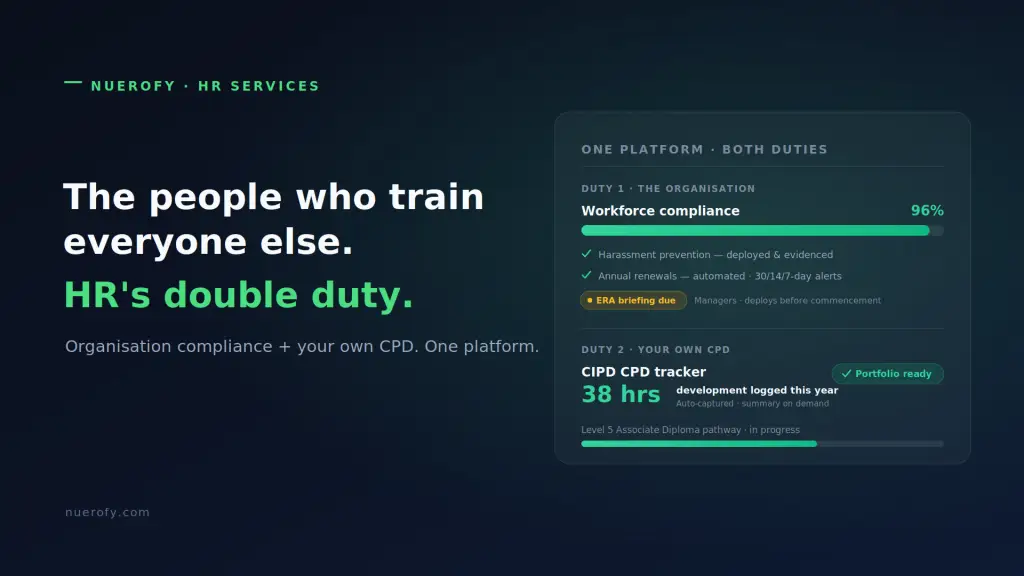
Every profession has its paradox, and HR’s is this: the people responsible for the training of the entire organisation must, at the same time, keep themselves current in one of the fastest-moving legislative environments in British employment history — while maintaining their own professional CPD as CIPD members. HR and L&D professionals are simultaneously the […]
Public Sector Training 2026: Compliance & Inspection-Ready

The scale is unmatched. The UK public sector employs an estimated 5.95 million people as of March 2024 — the highest level since 2012 — with roughly 2.0 million in local government and a further 546,000 in the Civil Service (ONS, 2024). This guide explains why training in this sector is uniquely demanding and what […]
Manufacturing & Production Training in 2026: Safety, Quality and the Skills Gap

In manufacturing, training isn’t a support function — it’s the thing standing between an operation and catastrophe. A single machinery incident, a batch quality failure or a regulatory non-conformance can stop a production line, trigger a product recall, or end a supplier relationship worth millions. No other sector is as acutely exposed to the consequences […]
Recruitment Training in 2026: Compliance, Consultant Performance and the AI Shift

In most businesses, training supports the people who deliver the service. In recruitment, training builds the service. A recruitment consultant’s entire value — to clients and candidates alike — comes from what they know: the market they work, the regulations they operate under, the consultative skill they bring to a brief, and the judgment they apply to […]
Recycling & Waste Management Training – Safety, Permits and Regulatory Reform

Few workforces in Britain answer to as much, or risk as much, as this one. Recycling and waste management is simultaneously one of the country’s most hazardous occupations and one of its most heavily regulated — accountable to the HSE for safety, the Environment Agency for permits, and now a wave of new legislation reshaping […]