
Shortlisting AI-native learning platforms? The questions that separate genuine AI from bolted-on features, and where to compare.
The LMS buying decision has changed shape. Two years ago the shortlist question was whether to choose an AI platform at all; the legacy options were familiar, and the AI-native ones felt like a bet. In 2026 the bet has been settled. AI-native platforms such as Sana, now part of Workday, and Nuerofy have proven the category, analysts describe the wider market as being rebuilt around AI, and the realistic shortlist for most buyers is now a choice between AI-native platforms rather than a choice about AI itself.
That makes the evaluation harder, not easier, because the marketing has converged. Every vendor now says AI-powered, every demo shows a course being generated, and the differences that will actually matter in year two of the contract sit below the surface: how the AI is built in, how the pricing works, what is included versus extra, and what you can prove when an auditor asks. This guide sets out the questions that surface those differences, whichever platforms are on your shortlist.
The AI test: what stops working if you switch it off?
Start with the question that separates AI-native from AI-bolted-on: if the vendor disabled every AI feature tomorrow, would the product still be essentially the same? For a legacy platform with an AI assistant added, the honest answer is yes, which tells you the AI is a feature, not the architecture. For a genuinely AI-native platform the product stops making sense without it: course creation, translation, personalisation and analytics all run through the AI layer. In the demo, make this concrete:
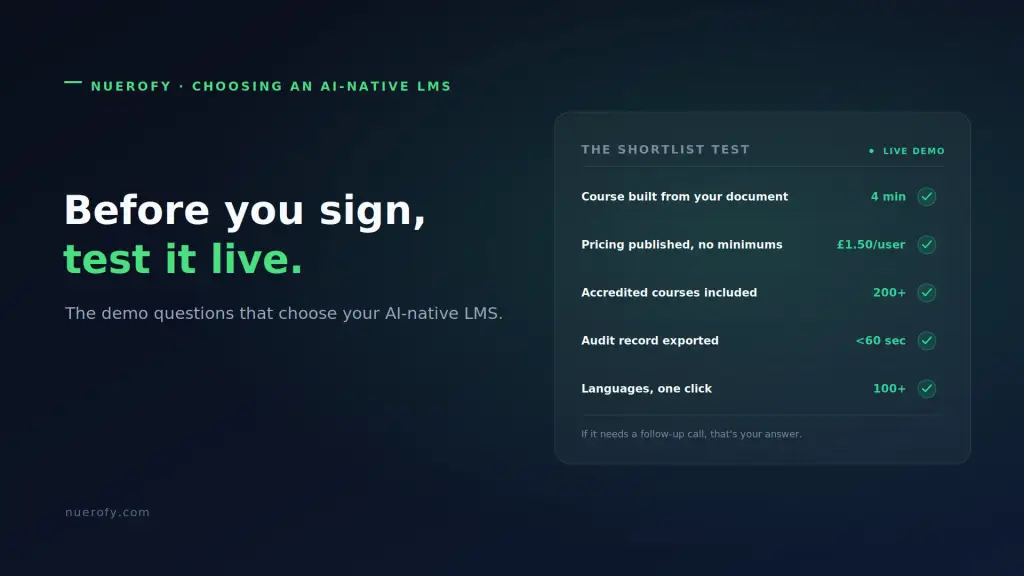
- Ask them to build a course live from one of your own documents, not a prepared sample, and time it.
- Ask how a course updates when the source policy changes: regenerated in minutes, or re-edited by hand?
- Ask what personalisation actually does: does an assessment genuinely route learners around what they already know, and what evidence sits behind the claimed time savings?
- Ask how many languages ship with AI voiceover, and whether translation is a click or a services engagement. Nuerofy, for reference, delivers courses in 100+ languages from the same build. A platform that passes these tests in front of you, on your material, is AI-native. A platform that needs a follow-up call has told you something too.
The money questions: price, minimums and what “included” means
Commercial structure is where year-two regret usually lives, and three questions expose it. First, is pricing published? Transparent per-user pricing you can plan around is still rare in this market; Nuerofy publishes its rate, from £1.50 per user per month, while many enterprise platforms price by custom quote, so ask every vendor for their pricing basis in writing. Second, is there a minimum? Some enterprise platforms carry minimum seat counts or contract values that quietly exclude smaller deployments, so if you have 80 or 300 users, ask directly whether the platform will take you, and at what effective per-user cost. Third, what does the licence actually include? A content library of ready-made accredited courses included in the price is very different from a marketplace of paid add-ons: Nuerofy includes 200+ RoSPA and CPD-accredited courses in its Learning Library as standard, and whatever platform you choose, the comparison only works once you know what sits inside each price and what sits outside it.
The proof questions: compliance, evidence and audit
If your training carries any regulatory weight, the demo should spend as long on reporting as on creation. Can the platform produce a complete, timestamped training record for a named individual in under a minute? Do renewals automate with alerts before anything lapses, or does an administrator chase a spreadsheet? Are audit trails tamper-resistant? Is accredited content available for the topics where generated text is not enough? These questions matter because they are the ones an inspector, a client auditor or an insurer will eventually ask you, and the platform’s answer becomes your answer.
The scale questions: who else has to live with this?
Finally, test the edges of your own organisation against the platform. Deskless and shift workers: does it genuinely work on a phone, offline where needed? Contractors and temporary staff: can they be inducted and evidenced without full licences and manual administration? Multiple sites, brands or entities: is there a real multi-site structure with local flexibility and central visibility? Managers: will they see live dashboards, or export CSVs? The platform that wins the demo in a head-office meeting room is not always the one that survives contact with a warehouse night shift, and this is where references from organisations shaped like yours are worth more than any feature list.
Where the head-to-head comparisons help
Generic evaluation frameworks only take you so far; at some point the shortlist becomes two names and you need the specifics side by side. If Sana is on your shortlist, our Sana alternative page sets out how the two platforms compare across AI capability, pricing approach, included content and compliance features, with the usual caveat that features and pricing change and you should confirm current details with each provider. It is the fastest way to see where the platforms genuinely differ and where they are closer than the marketing suggests, and the same questions in this guide will serve you in both demos.
The decision, in one sentence
Choose the AI-native learning platform whose AI you tested on your own documents, whose pricing you can explain to your finance director without a follow-up call, whose included content covers your compliance load, and whose evidence would survive your worst audit day. If you would like to run that test on Nuerofy, book a demo and bring a document: we will build the course, translate it and show you the audit trail in the same session.
Frequently asked questions
What is the difference between an AI-native LMS and an LMS with AI features? An AI-native platform is architected around AI: course creation, translation, personalisation and analytics all run through it, and the product would not function without it. A platform with AI features has added assistants or generation tools onto a traditional architecture. The practical test is what stops working if the AI is switched off, and how fast the platform can turn your own document into a deployed, assessed course.
What should AI LMS pricing look like? Ideally published and per-user, so you can model costs before a sales call. Many enterprise platforms price by custom quote and some carry minimum seat counts, so ask every shortlisted vendor for their pricing basis, any minimums, and exactly what the licence includes, in writing. Nuerofy publishes its pricing, from £1.50 per user per month.
Is a content library important if AI can generate courses? Yes, for compliance-critical topics. Generated content is ideal for your own policies and procedures, but areas such as health and safety, safeguarding and food safety benefit from accredited, professionally maintained courses. The strongest position is both: an AI builder for your material plus an included accredited library, rather than paying separately for each.
How should we compare Nuerofy and Sana? Run both through the same tests: a live build from your own document, pricing and minimums in writing, included content, compliance reporting depth and language capability. Our Sana alternative comparison sets out the differences as a starting point, and current details should always be confirmed directly with each provider.
How long should switching to a new LMS take? For modern AI-native platforms, days to weeks rather than months: user import, branding, content selection and first courses live quickly, with historical training records migrated for audit continuity. Ask each vendor for a written implementation plan with dates, and for a reference customer of your size who has completed it.