
The UK energy sector has been handed two instructions at once: deliver clean power by 2030, and do it safely in some of the most hazardous working environments in the economy. The first demands scale — DESNZ analysis estimates the clean energy workforce must nearly double, from around 440,000 in 2023 to roughly 860,000 jobs by 2030, growing about 10% every year (DESNZ Clean Energy Jobs Plan, 2025). The second demands rigour: live electrical systems, gas under pressure, confined spaces, turbine access a hundred metres above the sea. Between those two instructions sits a single function — workforce training — and it has never mattered more.
Because here is the sector’s uncomfortable arithmetic: every new wind technician, hydrogen operator and heat pump installer must be trained before the asset goes live, every transferring oil and gas worker must be reskilled without repeating what they already know, and every existing engineer must stay continuously certified — since in this industry, a lapsed certification means someone legally cannot enter a network zone. This guide sets out why energy, utilities and renewables training is uniquely demanding and what transition-ready looks like. The data throughout draws on our State of Energy, Utilities & Renewables Training Report 2026, worth reading in full if you own competence, H&S or L&D in the sector.
The most regulated workforce in British industry
Energy and utilities answers to more technical regulators simultaneously than any other sector: Ofgem for network licence conditions, the HSE for safety, the Environment Agency for environmental compliance, the Office for Nuclear Regulation for anything at or near nuclear facilities, plus the Drinking Water Inspectorate and Ofwat on the water side. A single distribution network operator may need to evidence competency to the HSE, Ofgem and the EA across different parts of the same operation — each with its own reporting expectations, each able to ask, at any time, whether every worker in scope was appropriately trained, when they were last assessed, and when their certification next falls due. Training governance here isn’t one relationship. It’s a portfolio.
Why energy L&D is harder than almost anywhere else
Three forces combine to make this the most strategically loaded learning environment in the economy.
- High-hazard operations, legally mandated training. Live-line electrical work, gas installation, confined-space entry and working at height all carry role-specific training duties under the Health and Safety at Work Act 1974, the Electricity at Work Regulations 1989, the Gas Safety (Installation and Use) Regulations 1998, WAHR 2005 and the Confined Spaces Regulations 1997 — where a single error can be catastrophic.
- The net-zero skills transition. Offshore and floating wind, hydrogen, battery storage, heat pumps, EV charging and smart-grid digitalisation each create entirely new training categories — curricula that must exist before the assets are commissioned, delivered alongside existing compliance training at full tilt.
- A field-based, dispersed, rotating workforce. The people who keep the lights on are in substations, cable tunnels and customers’ homes, or two-weeks-on offshore — not at desks. Certifications expire mid-rotation, and any training model that needs a classroom is structurally misaligned with the operation. Individually each would stretch any L&D function; together they define the sector’s decade: double the workforce, hold the standard, prove it to five regulators.
The H&S foundation every energy worker needs
Before anyone works on or near the network, a legally mandated baseline must be in place and evidenced. Across the sector it spans:
- Electrical and gas safety — electrical safety awareness under the Electricity at Work Regulations 1989 for all staff on or near electrical systems, and gas safety aligned to the Gas Safety Regulations 1998 and Gas Safe Register requirements.
- High-risk access — working at height for turbine access, tower climbing and substation roofs; confined spaces for cable tunnels, underground vaults and gas storage; and permit-to-work (PTW) systems for safe isolation and re-energisation.
- Substances and environment — COSHH covering SF6 gas, transformer oils, battery electrolytes, hydrogen and water treatment chemicals; environmental compliance including pollution prevention and spill response under EA enforcement.
- People and place — manual handling for field and installation roles, lone working for engineers, meter readers and remote renewables sites, and nuclear safety awareness under ONR expectations for relevant personnel. Every category carries renewal cycles and evidence obligations — and in a sector where certification governs physical access to the network, a paper tracking system isn’t an inefficiency; it’s an operational liability.
The transition curriculum: training that must exist before the asset does
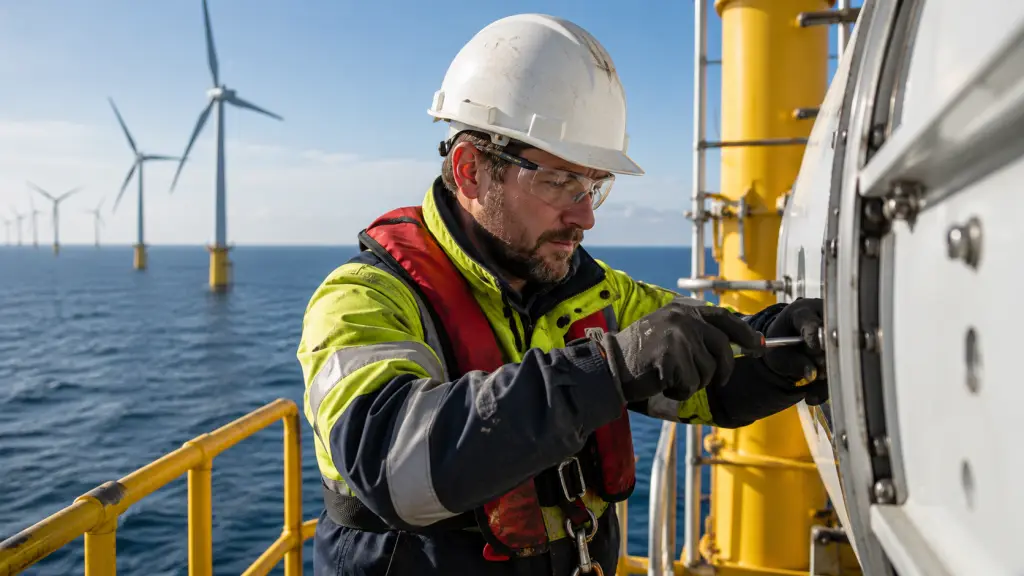
The net-zero build-out is the largest single technical upskilling challenge the UK economy has faced in a generation, and it has a hard sequencing rule: the training must be ready before the technology is energised. That means hydrogen safety and electrolyser operations built before the hydrogen hub opens; battery chemistry, thermal-runaway and DC-safety training before the storage site connects; turbine access, rescue and nacelle safety before the wind farm’s first rotation; F-Gas and commissioning procedures before the heat pump programme scales. This is exactly where traditional course development fails the sector — a months-long authoring cycle cannot precede assets arriving on this timetable. Purpose-built tools change the equation: with the AI Studio, an L&D team can turn an installation manual, a new-technology procedure or a regulatory guidance note into a structured, assessed course in minutes, so the curriculum ships with the asset rather than chasing it.
The same discipline now extends to the grid’s fastest-growing customers. Data centres – designated Critical National Infrastructure in 2024 – share much of the energy sector’s training DNA: high-voltage competence, battery and stored-energy safety, generator and fuel handling, and the “trained before energised” rule that governs every commissioning. As operators race to build AI-ready capacity, many are applying exactly the approach described here, which is why we now support data centre workforce learning as a sector in its own right.
Reskilling the transition workforce — without wasting a day
The good news inside the skills challenge: DESNZ analysis shows more than 90% of the UK’s roughly 120,000 oil and gas workers hold skills with medium-to-high transferability to offshore renewables. The waste to avoid is retraining people on what they already know. Smart placement testing solves it — assessing each transferring worker’s existing competence and building an individual pathway covering only the genuine gaps, cutting reskilling time by up to 60%. At transition scale, that efficiency isn’t a nicety; it’s the difference between the workforce doubling on schedule and the skills shortage constraining the build-out.
Field, offshore and the two-week rotation problem
Energy training has to reach people the office never sees. Field engineers need mobile-first modules that work on a smartphone with no app; remote-site teams need offline capability that syncs completions when connectivity returns; and offshore technicians — two weeks on, two weeks off — need renewal tracking smart enough to ensure no one mobilises for a rotation with a certification due to expire mid-hitch. Add pre-shift briefing tools that push a focused module on a specific task or hazard to every engineer’s device before mobilisation, and training stops being an event the field workforce misses and becomes part of how work is deployed.
Networks, assets and the supply chain in one picture
A transmission operator runs thousands of towers and hundreds of substations; a water company runs dozens of treatment works; an offshore developer runs vessels, marshalling yards and O&M hubs — and around all of them sits a deep tier of specialist contractors whose competence is the operator’s liability too. The structure that copes: asset- and site-level dashboards rolling up to a full network view, programme-specific training paths that auto-enrol workers assigned to a capital project or outage, consistent organisation-wide content with site-specific PTW and hazard layers, and contractor and supply-chain training managed through external training portals — so every tier of the workforce sits inside one compliance picture without extra administration.
How a modern, AI-native approach solves it
This is the gap purpose-built Energy, Utilities & Renewables workforce learning is designed to close. Rather than spreadsheets, paper certificates and classroom bottlenecks, a modern AI training platform brings compliance, transition skills and regulator evidence into one always-ready system:
- 200+ RoSPA and CPD-accredited courses — Electrical Safety, Gas Safety, Working at Height, Confined Spaces, COSHH, Manual Handling, Environmental Awareness, Lone Working and more — updated automatically as HSE guidance and legislation evolve.
- An AI course builder that converts PTW procedures, safe systems of work, risk assessments and new-technology manuals into interactive, assessed training in minutes — from a hydrogen safety induction to a site-specific isolation protocol.
- Smart placement testing for transition reskilling — identifying exactly which competencies each transferring worker already holds and building pathways for only the gaps, cutting reskilling time by up to 60%.
- Mobile-first, offline-capable field delivery with pre-shift briefing modules, plus automated 30/14/7-day renewal alerts to the worker, their supervisor and central H&S — so no engineer mobilises on a lapsed certification.
- Multi-site and supply-chain infrastructure — asset-level dashboards, programme-specific auto-enrolment, contractor portals, and a live competency matrix across every site and contractor tier.
- Regulator-ready reporting — Ofgem, HSE, EA and ONR-formatted compliance reports for any site, team or certification category in under 60 seconds, a complete individual training history in under two minutes for incident response, and 100+ language AI voiceovers for diverse field and installation workforces. The result is a sector operation that can double its workforce, transition its skills base and hold continuous certification — with the evidence ready before any regulator asks.
What “good” looks like — a quick checklist
If you’re assessing your own operation, answer these as a regulator would:
- If Ofgem, the HSE or the EA requested competency evidence for every person in scope within 48 hours, how long would it actually take — and would you trust the data?
- Do certification renewals alert the worker, supervisor and central H&S before anything lapses — including mid-rotation offshore?
- Does training for new technologies exist before the assets go live?
- Are transferring workers placement-tested so they train only on genuine gaps?
- Can field engineers complete training from a phone, offline, at a remote site?
- Is every contractor tier’s training status visible inside your compliance picture? If several answers are “no,” the exposure isn’t just regulatory — it’s the skills bottleneck that slows the build-out your business is counting on.
See it built for your network
The fastest way to grasp the difference is to see your own scenarios — a new battery site’s training pack, an offshore rotation’s renewal schedule, an Ofgem evidence request — running on a platform built for the sector. Book a demo and we’ll walk through it, or start a free trial and have real training live within days. For the full picture of the sector’s challenges and data, read the State of Energy, Utilities & Renewables Training Report 2026.
Frequently asked questions
What H&S training is legally required in energy and utilities? Role-specific training under the Health and Safety at Work Act 1974 and sector frameworks: electrical safety (Electricity at Work Regulations 1989), gas safety (Gas Safety Regulations 1998), working at height (WAHR 2005), confined spaces (Confined Spaces Regulations 1997), COSHH, permit-to-work systems, environmental compliance, manual handling and lone working — plus nuclear safety awareness under ONR expectations where relevant. All refreshed on defined cycles and evidenced.
Which regulators examine training in this sector? Ofgem (network licence conditions and competency management), the HSE (safety), the Environment Agency (environmental permits and incidents), the ONR (nuclear), and the Drinking Water Inspectorate and Ofwat on the water side. Each can request evidence of appropriate training for every worker in scope — so records should be exportable in regulator-ready formats on demand.
What new training does the net-zero transition require? Entirely new curricula: turbine access, rescue and nacelle safety for wind; DC electrical safety, battery chemistry and thermal-runaway awareness for storage; hydrogen properties, leak detection and electrolyser operations; F-Gas and commissioning for heat pumps; EV charging installation standards; and cybersecurity for smart-grid operational technology — each needed before the assets go live.
How should oil and gas workers be reskilled for renewables? With placement testing first: over 90% hold transferable skills (DESNZ, 2024), so each worker should be assessed and given a pathway covering only their genuine gaps — cutting reskilling time by up to 60% versus putting everyone through full programmes.
How does training reach offshore and remote field teams? Through mobile-first delivery with offline capability (modules downloaded before mobilisation, completions syncing when connectivity returns), pre-shift briefing modules pushed to devices, and renewal tracking that prevents anyone mobilising for a rotation with a certification due to expire mid-hitch.
Can contractors and the supply chain be included in one compliance framework? Yes — specialist contractors and supply-chain businesses can manage their workforces’ training through their own portals inside the operator’s platform, giving full supply-chain competency visibility across every asset and programme without added administration.