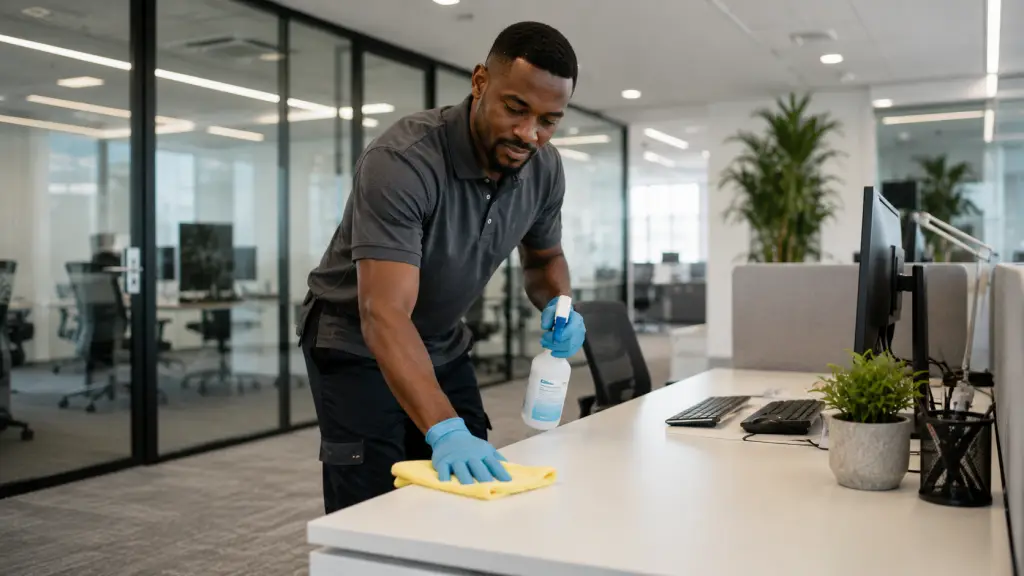

Every other sector trains its people for its own premises. Facilities management and cleaning trains its people for everyone else’s. A cleaning operative may start the week in a hospital ward, spend Wednesday in a school and finish Friday in a data centre — three client-controlled environments, three sets of site rules, three different induction requirements, all layered on top of the same legal baseline. And three different clients who can each demand evidence, at any review meeting, that everyone on their building is trained and current. In FM, compliance isn’t one relationship with one regulator. It’s won and defended contract by contract.
The workforce doing it is one of Britain’s largest and least celebrated. The UK cleaning, hygiene and facilities management industry directly employs 1.51 million people — roughly 5% of the entire UK workforce — across 78,915 businesses, contributing nearly £72 billion to the economy, with facilities management accounting for 47% of industry turnover (British Cleaning Council Research Report, 2025). This guide sets out why training in this sector is uniquely demanding and what contract-winning training governance looks like. The data throughout draws on our State of Facilities Management & Cleaning Training Report 2026, worth reading in full if you run FM or cleaning operations.
The layered compliance problem
Here’s what makes FM different from a factory or a warehouse: the compliance environment is stacked three deep. First, the FM employer must evidence training to the HSE, exactly as any employer must. Second, the client must satisfy themselves that their contractor’s workforce meets the site’s safety standards — a hospital’s infection control regime, a data centre’s access protocols, a school’s safeguarding expectations. Third, and increasingly decisive, the contract itselfscores training: major clients in healthcare, education, government and critical infrastructure now write evidenced training compliance into KPIs, review it quarterly, and weigh it at renewal. A lapsed COSHH certificate isn’t just an H&S liability — it’s a contract non-compliance sitting in a client’s scorecard.
Why FM & cleaning training is harder than almost anywhere else
Three forces combine to make this one of the toughest L&D environments in service industry.
- Hazard diversity across environments. Chemical agents, wet-surface slip risks, manual handling, lone working on early and late shifts, working at height for window and facade access, electrical and legionella risks in hard FM — the training baseline is wide, and it changes with every building type.
- Structural turnover and continuous onboarding. Annual turnover of 30–50% is not uncommon in cleaning; a contractor with 300 operatives may need to induct, train and deploy 100–150 new starters every year, each before they set foot on a client site.
- A workforce the classroom model was never built for. The sector is 58% female, spans dozens of nationalities and languages, has 42% of workers without a Level 2 qualification and 29% aged over 55 — operatives without desks, working shifts that never overlap with a training room’s opening hours. Individually each would stretch any operator; together they demand training that is broad, fast, mobile and multilingual — and evidenced to three audiences at once.
The H&S foundation every operative needs
Before anyone starts a shift on a client site, a legal baseline must be in place and evidenced. Across the sector’s health and safety training estate, the core categories include:
- Chemical and hygiene safety — COSHH training specific to the actual cleaning chemicals, disinfectants and sanitisers in use (generic modules don’t satisfy the HSE or protect operatives), plus infection control for healthcare, care home, school and food-facility cleaning.
- Physical hazards — manual handling for equipment, waste and consumables; slip, trip and fall prevention including wet-floor procedures and signage protocols; and working at height for window cleaning, facade access and high-level work.
- Building and technical risks — asbestos awareness for maintenance workers in older buildings, electrical safety awareness for hard FM and PAT testing, legionella awareness for water hygiene roles, and fire safety for all staff with warden training for supervisors.
- People and environment — lone working for early-morning and late-evening shifts in large or remote facilities, food hygiene for catering and kitchen cleaning, and equality, diversity and inclusion with emphasis on respectful conduct in client environments. Every category refreshes on a cycle, and every certificate must be traceable — which is where paper induction forms in site folders and certificates in supervisors’ inboxes quietly become both an HSE exposure and a failed contract KPI.
For the specific cycles, from COSHH to working at height, see our breakdown of how often each course needs renewing.
The onboarding engine: 100+ starters a year, ready before the first shift
At 30–50% turnover, onboarding in cleaning and FM is not an event — it’s a production line that never stops. Each new starter needs H&S induction, COSHH awareness, manual handling and a site-specific induction before their first shift, and the old model (a classroom day, a paper sign-off, a delayed start) cannot keep up. What can: automated employee onboarding that assigns the full pathway the day someone is added to the system, mobile-first delivery so operatives complete training from their own phone the evening before they start, digital certificates issued automatically on completion, and renewal alerts at 30, 14 and 7 days so the operative, their supervisor and the compliance team all see a lapse coming before it reaches a client site.
Fifty clients, three hundred buildings, one record
The multi-site problem in FM is more extreme than almost any other sector because every site belongs to a different client. A mid-sized contractor might serve 50 clients across 300 buildings — each with its own induction, access procedures, incident protocols and contract-specific requirements. Healthcare clients require NHS-aligned infection control; education clients require safeguarding awareness; data centres require security briefings. The structure that copes: a client-specific induction module for every building (built from the client’s own site rules), role-based pathways so cleaners, supervisors, engineers and grounds operatives each see only what’s relevant, subcontractor and agency portals so the extended workforce sits inside the same compliance framework, and a dashboard that can produce a client-ready compliance report for any building, any contract, any date range — in under a minute.
No client environment tests this more than a data centre. FM and cleaning teams working inside these facilities operate under Critical National Infrastructure-grade rules: strict access control, escorted zones, equipment that must never be touched, and induction evidence checked before anyone badges in. It’s demanding enough that we treat training for data centre environments as its own specialism — but for FM contractors, winning that work starts with exactly the induction and evidence infrastructure described above.
Training evidence as a commercial weapon
This is the part of FM training that deserves boardroom attention: in a competitive market, training governance wins work. The contractor that walks into a quarterly review with a live dashboard — every operative on the contract, every certification current, every renewal automated — is demonstrating governance quality that a rival with a folder of paper inductions simply cannot match. The same evidence becomes a tender asset: documented completion rates, renewal processes and client-specific capability included as standard in every bid. In FM and cleaning, the training record has quietly become part of the sales function.
How a modern, AI-native approach solves it
This is the gap purpose-built Facilities Management & Cleaning workforce learning is designed to close. Rather than paper forms and fragmented spreadsheets, a modern workforce learning platform brings the legal baseline, client-specific inductions and contract evidence into one always-ready system:
- 200+ RoSPA and CPD-accredited courses — COSHH, Manual Handling, Slips Trips and Falls, Working at Height, Fire Safety, Asbestos Awareness, Lone Working, Food Hygiene, Infection Control, Legionella Awareness and more — updated automatically as legislation evolves.
- Automated enrolment on first login — every new starter’s full induction and H&S pathway assigned the day they join, completed from a smartphone before their first shift, with digital certificates from day one.
- An AI course builder that turns a client’s site rules, emergency procedures, cleaning specifications or infection control protocols into a tailored induction module in minutes — so every contract mobilisation ships with its training pack built before the first operative starts.
- Client-specific inductions and role-based pathways across every building on every contract, with subcontractor and agency workers managed through their own portals inside your compliance framework.
- Contract-grade reporting — client-ready compliance reports for any site or contract in under 60 seconds, contract KPI reporting structured to each client’s metrics, tender evidence packs on demand, and automated 30/14/7-day renewal alerts that stop lapsed certifications reaching client sites.
- 100+ language AI voiceovers and visual, scenario-based content designed for operatives with varied literacy levels — so the whole workforce, in every language, receives the same quality of training. The result is a contractor that is HSE-compliant by default, client-ready at every review, and able to put training governance on the table as a reason to win the contract — not a risk to losing it.
What “good” looks like — a quick checklist
If you’re assessing your own operation, answer these as a client would:
- Could you produce a compliance report for any client’s building — every operative, every certification — in under a minute, live in the review meeting?
- Do new starters complete induction and H&S training from their phone before their first shift?
- Does every contract have a client-specific site induction, built from that client’s own rules?
- Is COSHH training specific to the actual products your operatives use?
- Do renewal alerts reach the operative, the supervisor and compliance before anything lapses?
- Is your training governance written into your tender submissions as evidence of quality? If several answers are “no,” the exposure is commercial as much as regulatory — sitting in the gap between the service you deliver and the governance you can prove.
See it built for your contracts
The fastest way to grasp the difference is to see your own scenarios — a new contract mobilisation, a client review dashboard, a 40-starter monthly intake — running on a platform built for FM and cleaning. Book a demo and we’ll walk through it, or start a free trial and have real training live within days. For the full picture of the sector’s challenges and data, read the State of Facilities Management & Cleaning Training Report 2026.
Frequently asked questions
What H&S training do FM and cleaning operatives legally need? A role-specific baseline including COSHH (specific to the chemicals in use), manual handling, slip, trip and fall prevention, fire safety, and — depending on role — working at height, asbestos awareness, electrical safety, legionella awareness, lone working, food hygiene and infection control. All of it refreshed on defined cycles and evidenced for the HSE and for clients.
How do client-specific inductions work across multiple contracts? Each client building gets its own induction module built from that client’s site rules, emergency procedures and contract requirements, deployed automatically to every operative working at that site — on top of the company-wide baseline. An AI course builder can create each module in minutes from the client’s own documents.
How can a cleaning contractor onboard 100+ new starters a year? Through automated enrolment (the full pathway assigned the day a starter is added), mobile-first delivery (training completed from a smartphone before the first shift), automatic digital certificates and automated renewal tracking — removing the administrative overhead that makes high-turnover onboarding unmanageable on paper.
Why does training evidence matter commercially in FM? Because major clients score evidenced training compliance in contract KPIs and weigh it at renewal, and tenders increasingly require documented training governance. A live compliance dashboard in a client review — and a tender evidence pack showing completion rates and renewal processes — is a demonstrable quality advantage over competitors.
Can subcontractors and agency workers be included in the same compliance framework? Yes — subcontracted companies and agency workers can manage their training through their own portals inside the principal contractor’s platform, giving full visibility of the operational workforce on every contract without extra administration.
Can training be delivered to multilingual FM teams with varied literacy levels? Yes — courses can be delivered with AI voiceovers in 100+ languages, using visual, scenario-based content designed for operatives with varied literacy — so one of Britain’s most diverse workforces receives consistent, accessible training.