
Ask most L&D, HR or compliance leaders what their LMS is for, and you’ll get a version of the same answer: it stores courses, records completions, and — when someone asks — produces a report. It’s a system of record. Useful, necessary, and almost entirely passive.
The problem is that “passive” no longer cuts it. Boards now expect L&D to prove its impact, regulators expect compliance to be demonstrable on demand, and the data to do both is sitting right there in the platform. It’s just locked away — accessible only through hours of manual report-building, and only ever telling you what already happened. The most powerful thing a modern learning platform can do isn’t store more data. It’s turn that data into answers, in seconds, before problems become incidents.
This is where AI changes the job description of the LMS entirely. Here’s the problem it solves, and what it looks like in practice.
The measurement gap nobody wants to admit
There’s a quiet crisis in corporate learning, and it isn’t a shortage of data. It’s a shortage of answers.
Organisations pour well over $100 billion a year into corporate training globally, yet most still can’t say what it returns. In one widely cited finding, 92 per cent of business leaders said they could not see the impact of their learning initiatives, and only around 13 per cent of companies measure L&D’s return at all. Industry analysts are blunt about the cause: a lack of analytics capability is now one of the biggest barriers stopping L&D from proving its value and defending its budget.
As one L&D report put it, the challenge isn’t a lack of data — it’s knowing which numbers actually demonstrate value, and being able to get to them without a week of spreadsheet work. Completion rates and login counts are easy to pull and tell you almost nothing. The metrics that matter — who’s at risk, where knowledge is failing, whether you’re genuinely compliant — are buried.
Meanwhile, the cost of not knowing is rising. A lapsed certification you spot a month late is a compliance exposure. A cohort quietly falling behind on mandatory safety training is an incident waiting to happen. Traditional reporting finds these things in the rear-view mirror — after the deadline, after the audit notice, after the near-miss.
From a system of record to a system of intelligence
The shift that makes the difference is moving the data layer from passive to active. Instead of you interrogating the platform, the platform works for you. Three capabilities make that real.
1. Ask your data a question — in plain English
The single most powerful change is the simplest to describe: you ask, in ordinary language, and you get an answer.
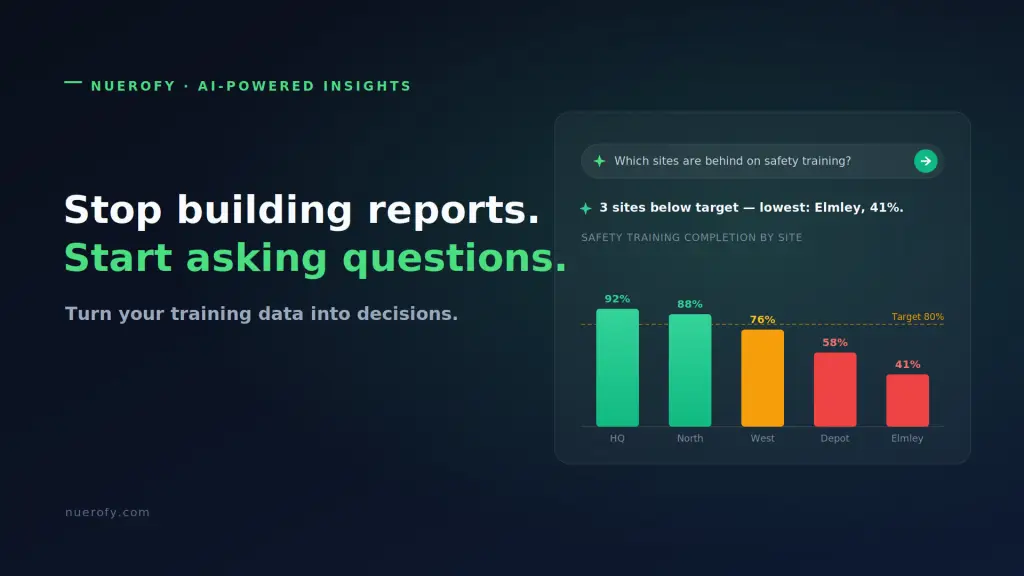
“Which sites are behind on fire-safety renewals?” “Show me completion rates for the new manager cohort versus last year’s.” “Who hasn’t started their GDPR refresher?” Instead of choosing filters, exporting a CSV and building a pivot table, you type the question and get back a clear answer and a chart. Natural-language analytics collapses the distance between having a question and getting the answer from hours to seconds — which means people actually ask, and decisions get made on evidence instead of gut feel.
This is also what frees the team. The hours currently lost to assembling the monthly board pack or the quarterly compliance summary largely disappear when reports generate themselves.
2. See the problem before it happens
Retrospective reporting tells you who already failed. Predictive analytics tells you who’s about to — while you can still do something about it.
By reading patterns across engagement, pace and performance, AI can forecast which learners are unlikely to finish on time and flag them early, so you can intervene with a nudge, a reassignment or a bit of support before a deadline is missed. For compliance-critical training, that’s the difference between managing risk and discovering it. The same intelligence applied to assessments surfaces which specific questions learners consistently fail, pointing straight at the content — or the underlying knowledge gap — that needs fixing, rather than leaving you to guess why scores are soft.
3. Audit-ready, automatically
For regulated organisations, the audit is the moment of truth — and traditionally a scramble. Where’s the evidence this person completed their training? When does that certification expire? Can we prove it?
An intelligent platform answers all of that continuously rather than frantically. Detailed, tamper-resistant audit trails log every login, course access and completion. Certification-expiry tracking watches renewal dates and sends reminders automatically, so lapses are prevented rather than discovered. And audit-ready reports — formatted to regulatory standards — generate on demand. The audit stops being a fire drill and becomes a button.
The real test: what questions can your platform answer?
Here’s a practical way to judge any learning platform, including your current one. These are questions you should be able to answer in seconds, today:
- Which teams or sites are behind on mandatory training right now?
- Which individuals are likely to miss their next compliance deadline?
- Which assessment questions are people failing most often — and why?
- Which certifications expire in the next 30, 60 and 90 days?
- How does this quarter’s engagement compare to last quarter’s, by department?
- If an auditor asked for proof of completion for any employee, how fast could you produce it?
If answering those means exporting data and building something by hand — or worse, if you simply can’t — that’s the gap. It’s not a gap in your data. It’s a gap in intelligence.
Why this is the feature that earns L&D its seat at the table
Course creation gets the attention, but analytics is what changes L&D’s standing in the business. When you can walk into a leadership meeting and answer “is the training working?” with evidence rather than anecdote — when you can show risk being caught early and compliance being maintained automatically — learning stops looking like a cost centre and starts looking like a control system for capability and risk. That’s the strategic shift every L&D function is being asked to make, and it runs entirely on having answers at your fingertips.
The research behind this piece
The pressure here is well documented. Studies consistently find that the vast majority of business leaders — around 92 per cent in one widely cited figure — struggle to see the impact of their learning spend, and that only a small minority of organisations formally measure L&D’s return. Analysts including McKinsey and multiple State of Digital Learning reports point to weak measurement and analytics as a primary reason L&D struggles to prove strategic value and defend investment, even as global corporate training spend exceeds $100 billion a year. The constraint, repeatedly, isn’t data volume. It’s the ability to turn data into timely, trustworthy answers.
How Nuerofy does this
Nuerofy’s AI-Powered Insights let you ask questions in natural language and get instant answers, charts and reports — no manual report-building. Predictive learning insights forecast which learners are likely to fall behind and flag them early, while assessment analytics pinpoint the exact questions and skill gaps holding people back. For compliance, comprehensive audit trails, automated certification-expiry tracking and audit-ready reporting mean you’re always inspection-ready, not scrambling. It’s the difference between an LMS that records what happened and one that tells you what to do next.
If your current platform makes you build the report before you can ask the question, that’s exactly the gap we close.
See AI-Powered Insights in action → Start a free trial or book a demo